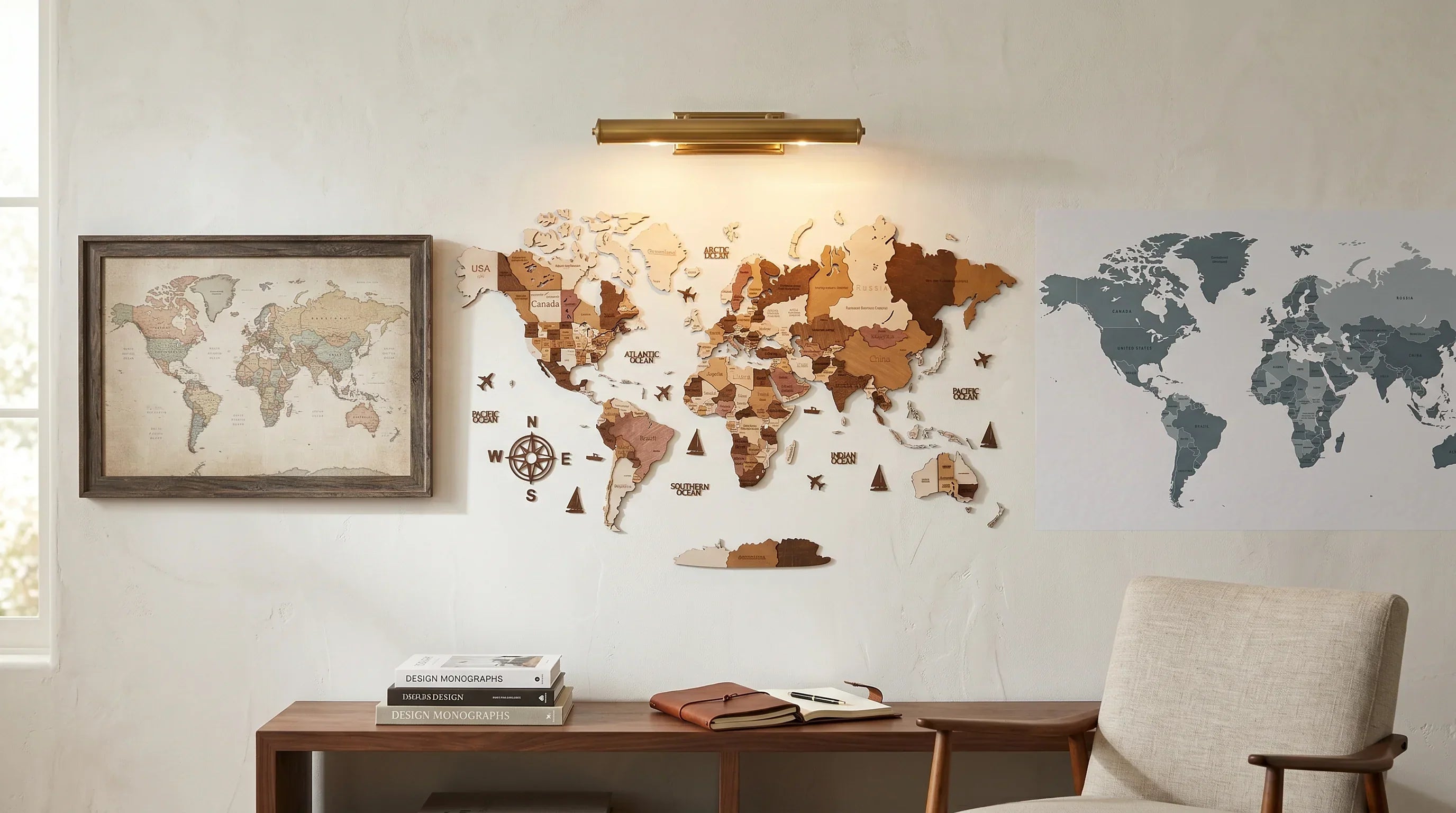
People talk about this as if it were a single choice with one right answer. It isn't. Canvas wins on cash. Vinyl wins on temporariness. Wooden wins on depth, pins, and time. The real comparison isn't which material is best — it's which one is right for the wall you're standing in front of.
What you actually get from each
In a wooden map vs canvas decision, the honest math looks like this. WOW WOOD's 4 mm birch plywood maps run €119 to €269 and hold up for 20+ years with proper installation. A printed canvas wall map costs €15 to €60 and fades in 3 to 5 years. Vinyl wall stickers cost €10 to €30 and survive 1 to 3 years before edges lift. Three different products, three different jobs.

The question behind the question
When a reader types "wooden map vs canvas" into a search bar, they aren't asking a material question. They're asking: which one belongs on my wall — given the room I live in, the years I'll be here, and the kind of object I want to live with.
Canvas is a print on cotton. Vinyl is a decal on adhesive plastic film. Birch plywood is five thin sheets of birch glued perpendicular to each other — structurally stable, lightweight, slightly translucent in direct sunlight. Three materials, three histories, three price points — three different reasons they end up on walls.
The choice depends on how you intend to look at the thing.
Side-by-side: 12 factors compared
The most-screenshotted table on this site is below. Every cell is defensible. Every cell is a buying decision.
| Factor | Wooden (birch plywood) | Canvas | Vinyl |
|---|---|---|---|
| Price range (160×85 cm size) | €119–€269 | €15–€60 | €10–€30 |
| Lifetime (typical) | 20+ years | 3–5 years | 1–3 years |
| 3D depth | Yes (4 mm layered) | No (flat) | No (flat) |
| Pins functional | Yes | No | No |
| Weight (L size) | 3.1 kg | ~0.8 kg | ~0.2 kg |
| Installation | Acrylic dots, 90 min | Hooks/nails, 5 min | Peel-stick, 30 min |
| Damage-free removal | Yes | No (nail holes) | Sometimes |
| UV fading risk | Minimal | High | Moderate |
| Languages available (this product) | 8 (WOW WOOD) | Usually 1–2 | Usually 1 |
| Recyclability | Birch is FSC-eligible | Cotton mostly recyclable | Plastic, low |
| Premium aesthetic | High | Medium | Low |
| Best for | Long-term homes, gift, statement | Renters, short-term, low budget | Kids' rooms, removable decor |
Read the table for the row that matters to you. If you're a renter signing a one-year lease, look at "Installation" and "Damage-free removal" first. If you mark trips with pins, look at "Pins functional" — there are only three Yes cells in that row, and two of them aren't this article. If you care about how the wall looks under afternoon sunlight in March, look at "UV fading risk."
Canvas maps: when they're the right choice
A printed canvas map is a fair object at a fair price. Stretched cotton over a wooden frame, an inkjet pigment or dye print on top, two D-rings on the back. Hang it on a single nail in five minutes.
Canvas wins clearly in three cases. First, when budget is tight — €15 to €60 buys a respectable wall object. Second, when the wall is decorative rather than functional — you want a map, not a record. Third, when the room itself is temporary — a rental, a shared flat, a kid's room that will become a study in two years.
The honest weakness of canvas is fade. The difference is the ink. Pigment-based inks bond to the fibre and resist UV; dye-based inks soak into the substrate and oxidise faster. Epson's UltraChrome archival pigment specifications document indoor display lifetimes of decades for pigment-on-canvas under normal lighting, with dye-based consumer prints falling well short — visible fading on dye-on-cotton-poly canvas within 2 to 5 years on a sunlit wall is consistent with the manufacturer's own archival ratings. Read the spec sheet before you hang anything south-facing. The second weakness is depth, which there isn't any. Canvas is flat. The third is pins, which it cannot hold without tearing.
Vinyl wall stickers: when they work
Vinyl decals occupy a specific corner of the market. They are inexpensive, they are removable (usually), and they are entirely flat. The film is roughly 0.1 mm thick. The print is a UV-laminated overlay on adhesive PVC.
Vinyl is the right choice in two contexts. A child's room — a world map decal above a desk, removed in three years when the child wants something else. A short-term rental — temporary decor that won't survive a move anyway. Most vinyl wall map manufacturers, including major decal brands like RoomMates and Asian Paints' Nilaya range, document an indoor lifespan of roughly 1 to 3 years in their own care guides before edges begin lifting and colour shifts toward yellow.
The structural weakness is removal. Vinyl removes cleanly off freshly painted walls. It often takes a layer of older paint with it. It will not survive a move. It cannot be re-applied. And — for the buyer interested in this article — it cannot hold pins, has no depth, and reads as decorative rather than archival.

Wooden maps: the premium option
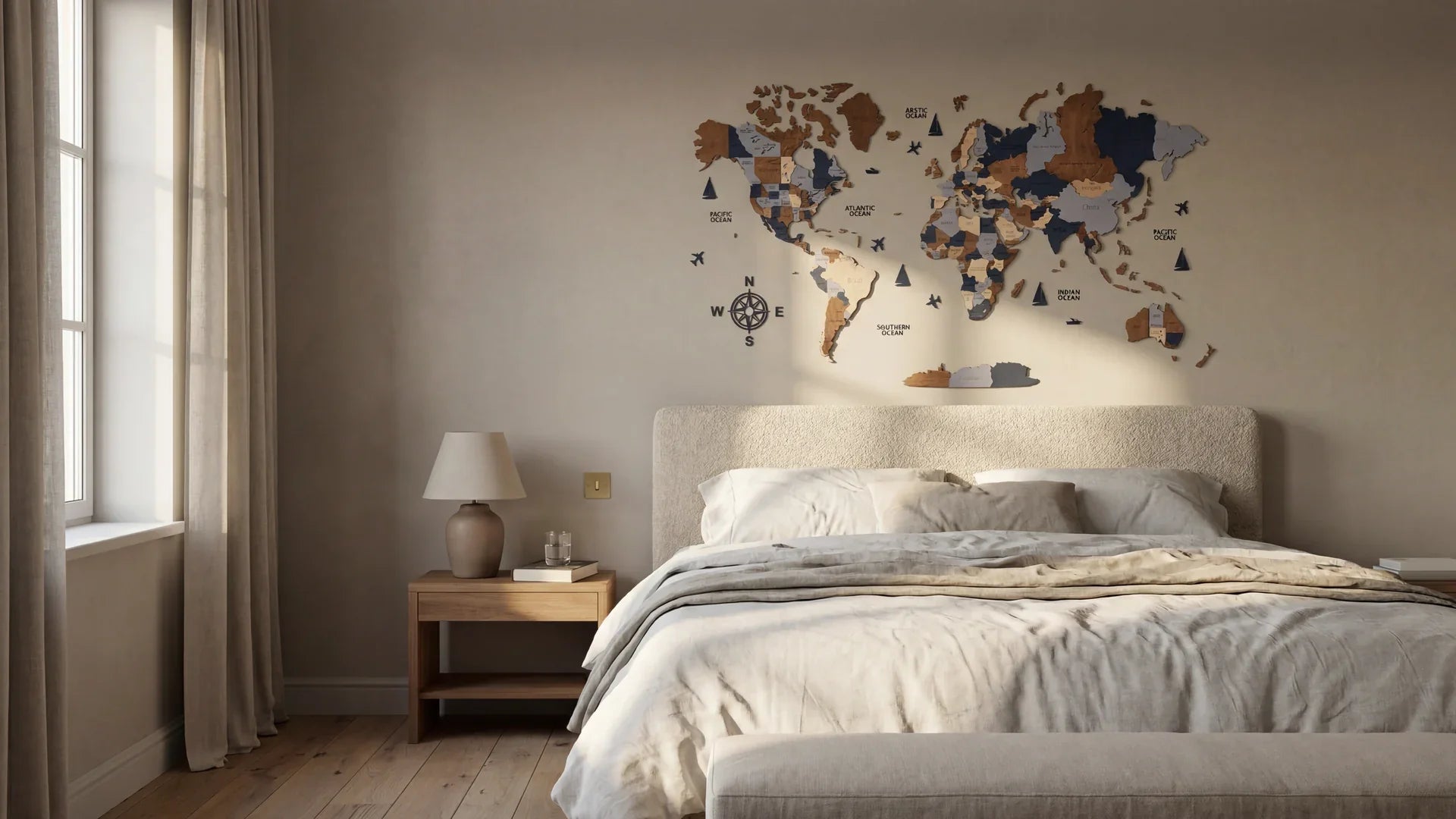
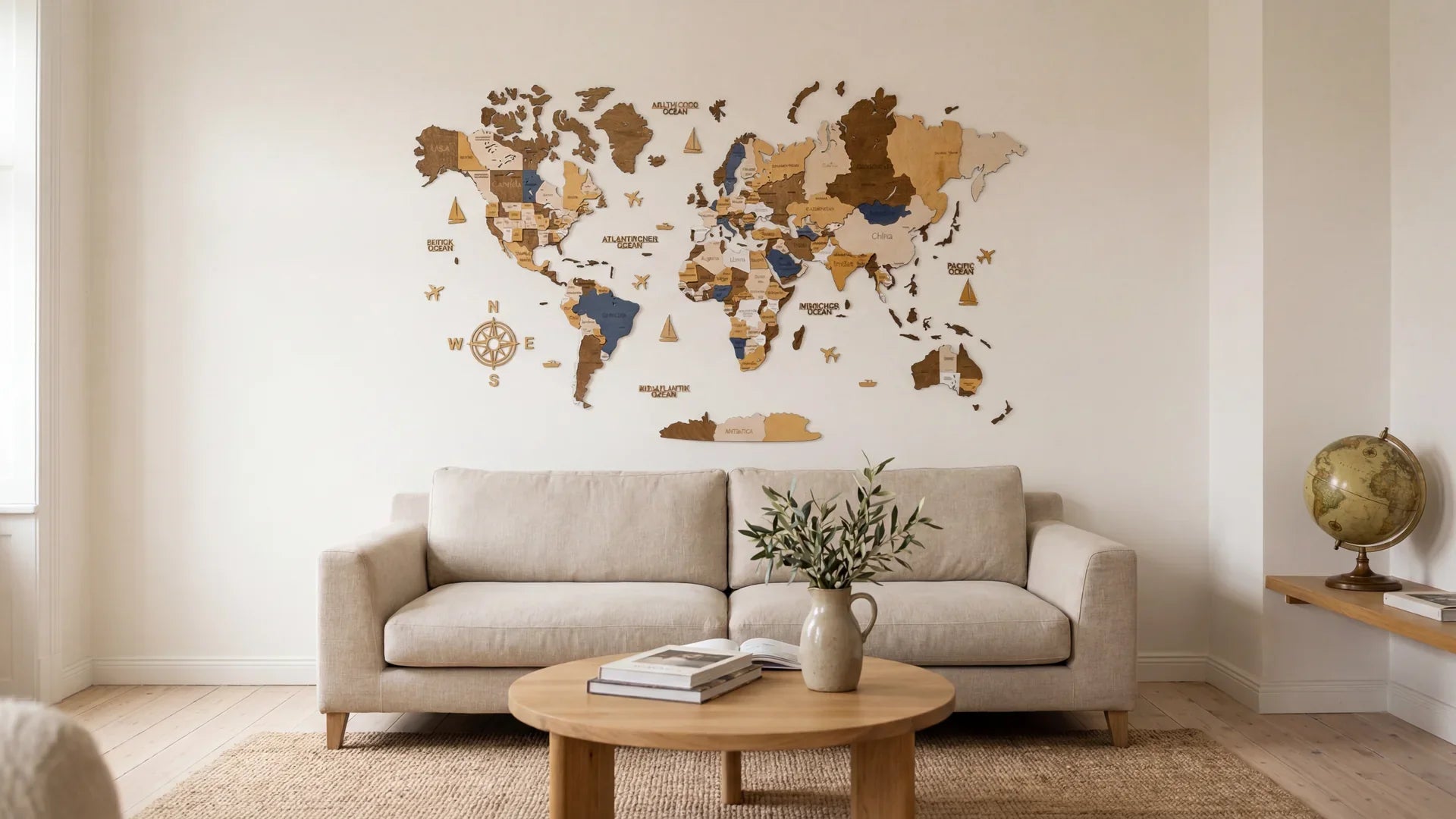
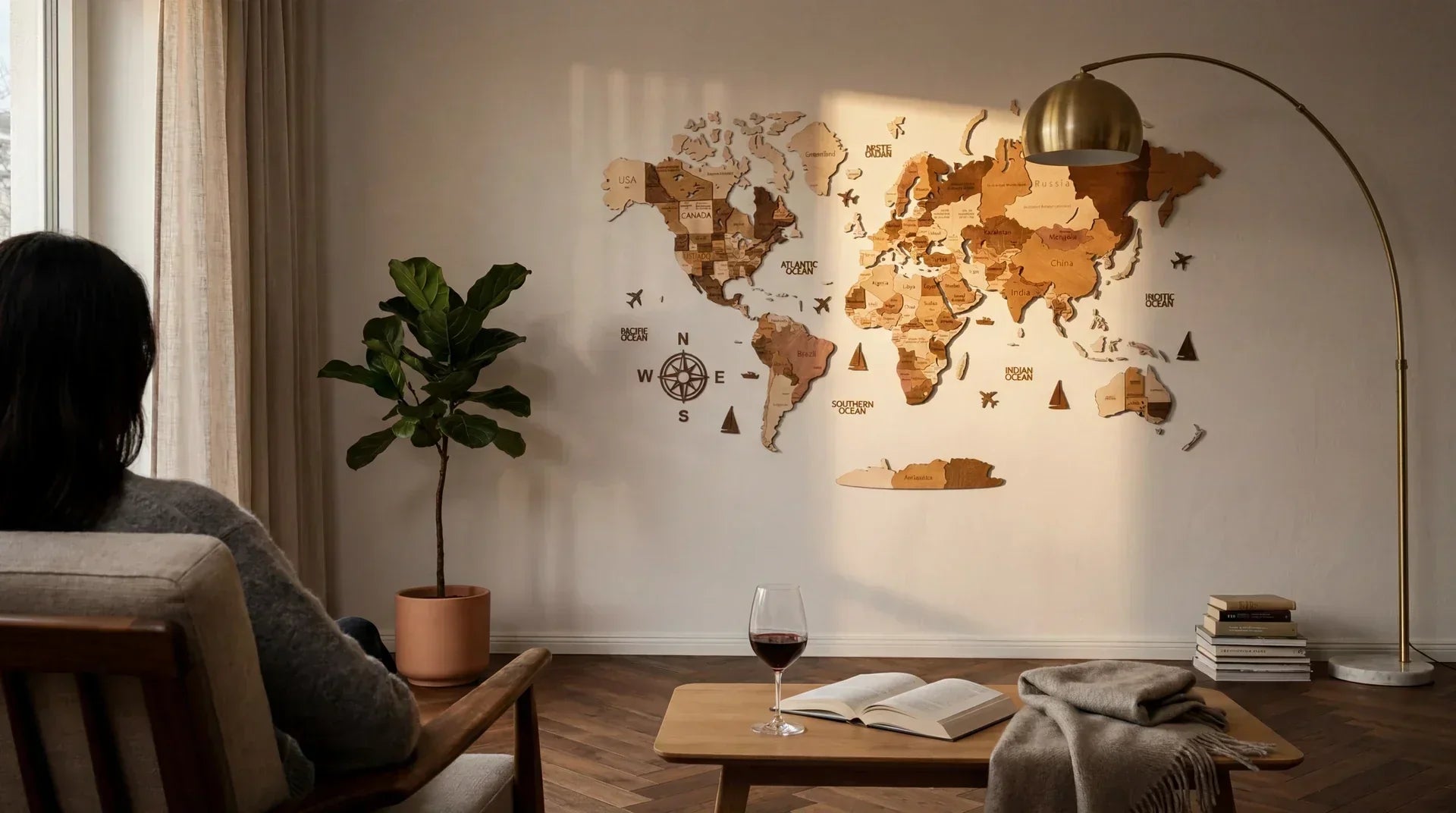
A wooden world map at 4 mm birch plywood is a different category of object. It is not flat. The continents are laser-cut in layered relief; you can see the shadow under each continent at an angle, and you can feel the grain of the sheet stock under a thumbnail. It is structurally stable, lightweight for its size, and — under direct afternoon light — slightly translucent at its thinnest points.
The thirty-year question is fade, and the answer here is short. Birch plywood does not fade. The surface oxidises and deepens in colour over a decade or two; a Natural Wood map at year fifteen reads warmer than at year one. This is patina, not damage. The anthropologist Tim Ingold, Chair in Social Anthropology at the University of Aberdeen, has written for years — most directly in Making (Routledge, 2013) — about materials as participants in time rather than as inert surfaces. Birch plywood is a textbook case. The grain moves with the room. It does not degrade against it.
WOW WOOD is a European brand, handcrafting 4 mm birch plywood maps in three finishes (Natural Wood, Dark Brown, Multicolor), three sizes (M, L, XL), 297 pins included, eight language editions, with no-drill installation using acrylic adhesive dots — which is also how the map comes off the wall without leaving a mark when you move. For context on the material itself, see what makes birch plywood different. For the larger shift in homes away from printed wall decor, see the 2026 shift from canvas to wood.
At a glance — WOW WOOD wooden world map specs
| Size | Dimensions | Weight | Price |
|---|---|---|---|
| M | 120 × 65 cm | 1.6 kg | €119,00 |
| L (bestseller) | 160 × 85 cm | 3.1 kg | €229,00 |
| XL | 213 × 113 cm | 4.5 kg | €269,00 |
Includes 297 wooden pins · acrylic adhesive dots · illustrated installation guide in 8 languages · premium gift packaging · free EU shipping · lifetime replacement of small parts.


The lifetime math
This is where the wooden map vs canvas question stops being subjective. Cost-per-year is plain arithmetic.
A canvas map at €30 lasts roughly 3 to 5 years before visible fade. Call it four. That's €7,50 per year on the wall, plus the work of finding a replacement and the wall holes from the first one.
A vinyl decal at €20 lasts 1 to 3 years before edges lift. Call it two. That's €10 per year, plus the cost of repainting where the decal stripped paint.
A WOW WOOD L map at €229,00, with a documented 20+ year lifetime and lifetime replacement of small parts, works out to €11,45 per year over twenty years — or €7,63 per year over thirty, which is the more honest figure given how birch plywood ages. After year four, the wooden map is cheaper per year than the canvas map. After year fifteen, it is cheaper per year than buying replacement canvases over the same period.
This is not a flattering calculation for premium products in most categories. It is for this one. The reason is depth and material — neither canvas nor vinyl are durable wall objects. They are printed images on perishable substrates. Birch plywood is a structural object that happens to be a map.
What about mixed approaches?
You do not have to pick one. Many homes do not.
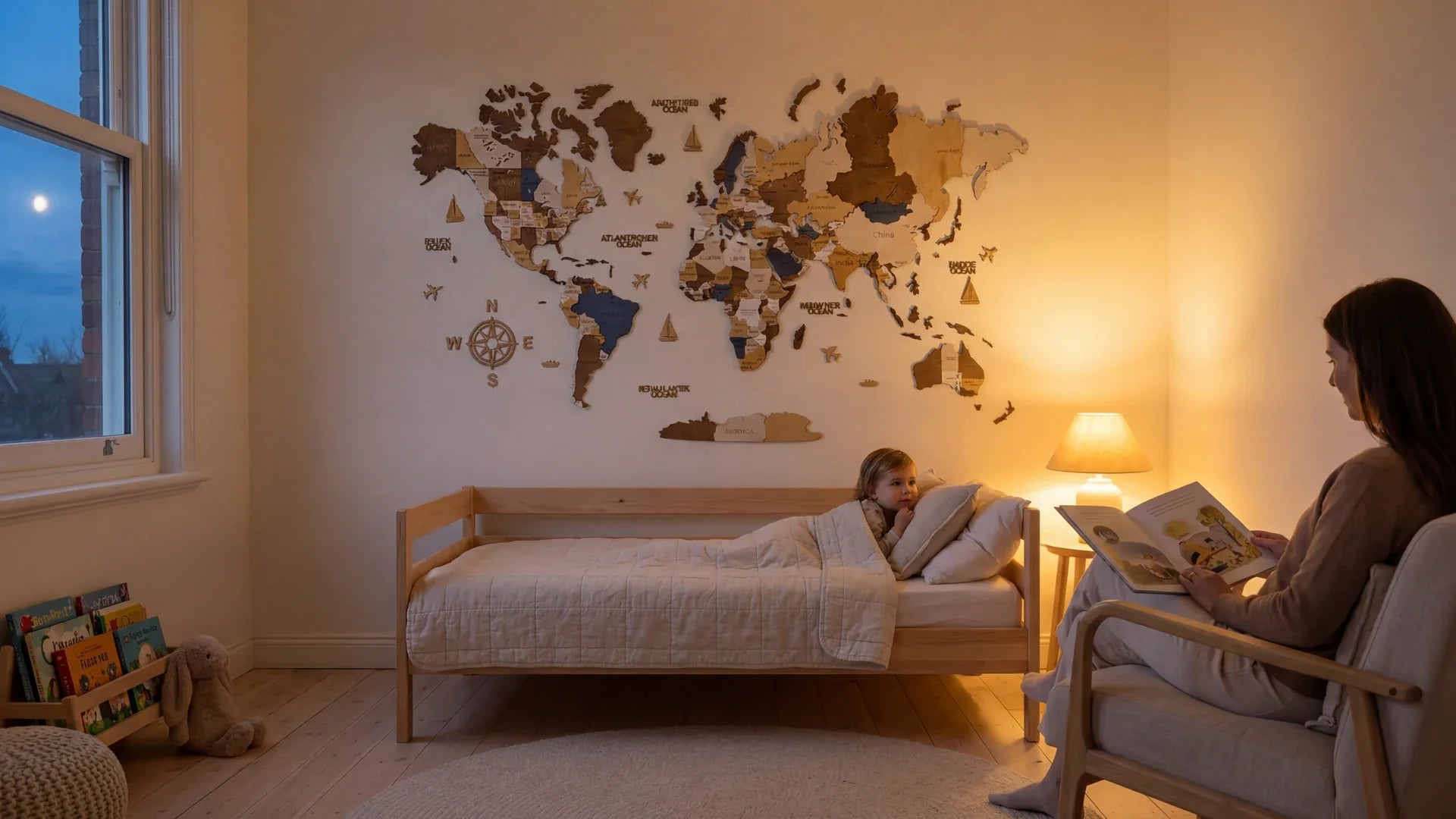
A reasonable mixed approach: a canvas world map in a kid's room for three years (cheap, replaceable, fine with crayon), a vinyl decal above a desk in the same house (temporary, low-stakes), and a wooden map in the main living room (long-term anchor, depth, pins for trips). Three rooms, three materials, three budgets. Nothing about owning a wooden map prevents owning a canvas one.
The argument for the wooden map in the room you most live in is depth and time. The argument for canvas in the room you least live in is cost and replaceability. They are not the same product. They are not competing for the same wall.
Choose based on these three questions
If you've read this far, the decision narrows to three short answers.
How long will you be in this home? Under three years — vinyl or canvas. Three to seven years — canvas or wooden. Over seven years — wooden, because you'll outlast any printed alternative twice over.
Do you want pins? If yes, wooden. Canvas and vinyl cannot hold them. Pins are the difference between a wall decoration and a daily record of trips.
Does the room get direct sunlight? If yes, the fade math swings hard against canvas and vinyl. A south-facing wall is hostile to dye-based inks and laminated PVC. It is neutral to oxidised birch.
If the answer is long, yes, yes, the wooden option lives at wow-wood.eu/collections/wooden-world-maps. Three sizes, three finishes, 297 pins, eight languages. If the answer is short, no, no, buy the canvas and don't overthink it.
Frequently Asked Questions
Are wooden world maps better than canvas?
How long does a canvas map last on a wall?
Can you use pins on a canvas map?
What's the cheapest wall map option?
Are wooden maps worth the price?
Related reading
People talk about this as if it were a single choice with one right answer. It isn't. Canvas, vinyl, and wooden maps are three different objects doing three different jobs on three different timescales. Pick the one that matches the room you live in and the years you intend to spend there. That's the whole comparison.
Written by David Holm for the WOW WOOD editorial team. We've helped European households style their wooden world maps since 2022.


Share: