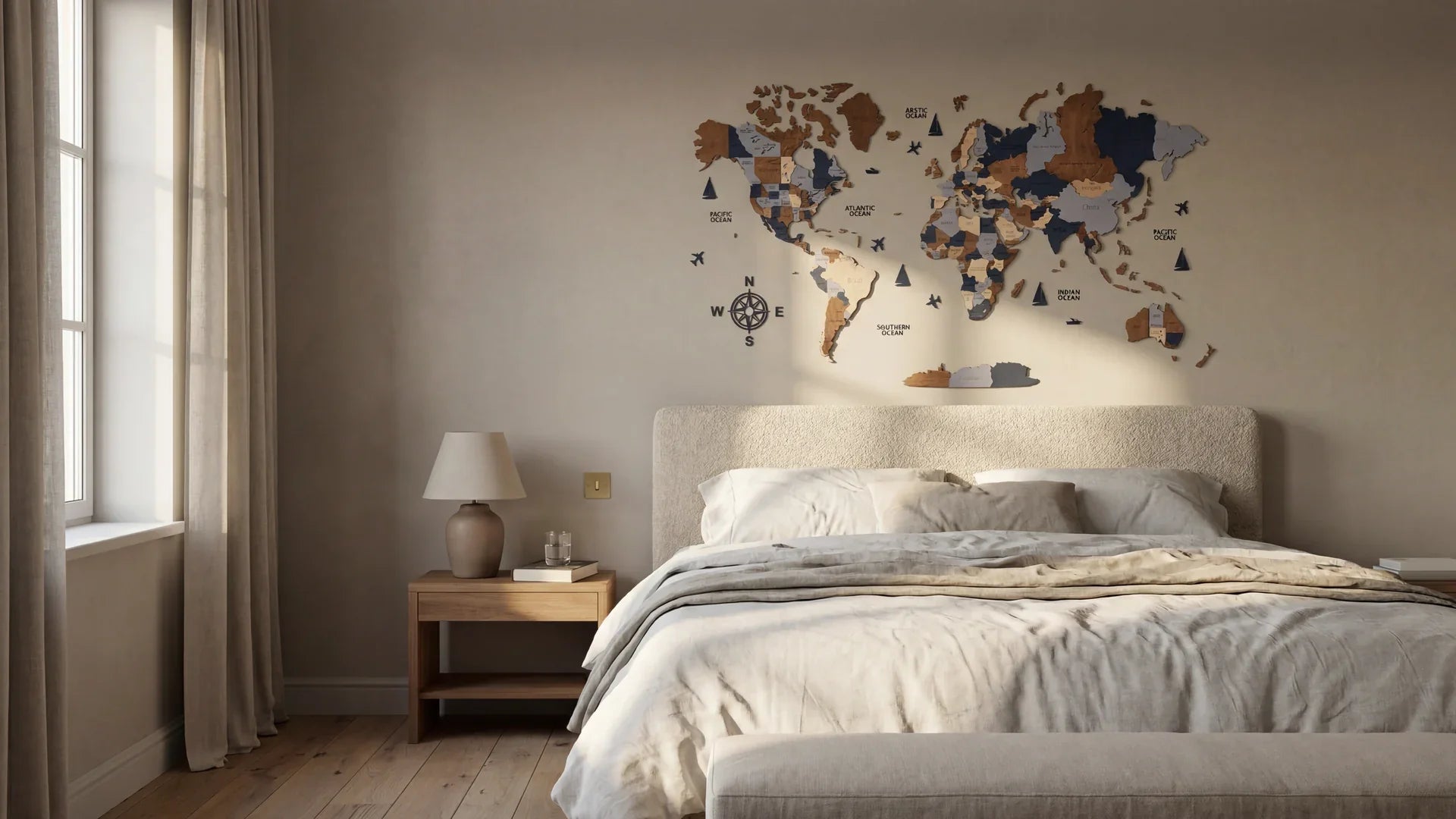
There is a moment, a week or so after you finally hang something above the bed, when you notice you have stopped fussing with the cushions. You do not decide it. You lie down one evening and the wall is settled, and so are you. The bedroom had been waiting for one quiet thing, and you did not know it until it arrived.
The Bedroom Wall Is Not the Living Room Wall
A living room wall is performed. It is seen by guests, framed behind every video call, judged from the doorway. It rewards a confident anchor, which is the whole argument of our living room wall decor guide.
The bedroom wall is the opposite kind of surface. Almost no one else sees it. It is the first thing you look at when you wake and the last before you turn off the lamp, and that is the only audience that matters. So the question changes. Not what impresses, but what calms.
This is the principle the Belgian architect Vincent Van Duysen has built a career on. In Vincent Van Duysen: Works 2009–2018 (Thames & Hudson, 2018), his interiors return again and again to reduction and to the warmth of touched materials: few objects, honest surfaces, nothing that asks to be noticed. A bedroom is the room where that approach earns its keep. You are not entertaining in here. You are trying to sleep.
So most of what works on a living room wall is wrong above a bed. Bright contrast keeps the eye busy. A dense gallery of frames gives you fourteen things to scan when you want zero. The bedroom asks for one object, low in contrast, warm to look at, and then quiet.
Above the Bed: How Big, How High
The sizing rule is borrowed from gallery hanging, and it is the same one that governs any piece over furniture. The decor should be about two-thirds of the width of the thing it sits above. In the bedroom, that thing is the headboard, not the bed frame and not the wall.
For a standard 140 to 160 cm double headboard, two-thirds lands around 95 to 110 cm of decor width. For a 180 cm king headboard, around 120 cm. Measure the headboard, multiply by 0.67, and you have your target before you look at a single product.
The map comes in three finishes, and each reads differently in a bedroom: Natural Wood (pale, Scandinavian, soft), Dark Brown (espresso, warm, quiet), and Multicolor (graphic, brighter, better suited to younger rooms). Every size and finish ships with 297 pins, though many people leave a bedroom map unpinned, or mark only a handful of places that mattered.
How big should art be above a bed?
Between 60% and 75% of the headboard width. Below 60%, the piece floats and the wall reads half-finished. Above 75%, it crowds the bed and the room loses its air. For most double beds that means a piece somewhere between 95 and 120 cm wide, which is why the M and L maps cover the great majority of bedrooms.
How high should you hang decor above a bed?
Bottom edge 15 to 20 cm above the headboard. Closer than the living room rule, on purpose. A small gap reads the decor and the bed as one calm block. Stretch the gap past 25 cm and the piece drifts up the wall, the headboard is orphaned below it, and you have invented a strip of dead plaster you will keep noticing. If there is no headboard, measure from the top of the mattress and hang the piece so its centre sits around 150 to 160 cm from the floor.

What to Hang Above the Bed: Five Calm Options
What should I hang on my bedroom wall?
Five things cover almost every good bedroom wall. A wooden map. A textile. A single large print or photograph. A mirror. Or nothing.
A wooden world map reads as object rather than image. The layered birch has real depth, so it holds up in low lamplight when a flat print goes dead. It is warm, it is matte, it does not glare back at an overhead bulb.
A textile, a flat-woven hanging or a large linen panel, is the softest option and the quietest. It absorbs sound, which a hard-floored bedroom needs, and it brings no shine at all. The cost is upkeep: fabric holds dust and is harder to clean than wood.
A single large print or photograph works if the frame is generous and the image is calm. One wide, low-contrast image beats four small busy ones above a bed every time.
A mirror brings light and depth to a dark or small room. The catch is what it reflects. A mirror above the bed shows you the ceiling light and the far wall, so place it only where the reflection is something restful.
And nothing is a real choice, not a failure. More on that below.
Is it OK to hang a world map above a bed?
Yes, and it is one of the calmer things you can put there, as long as you pick the finish for the room rather than for the photograph. A map above the bed is not loud. It is fine-grained: continents and coastlines read as texture from across the room, not as a slogan. In Natural Wood or Dark Brown it sits quietly behind you while you sleep and gives you somewhere to rest your eyes in the morning. Save the Multicolor for a teenager's room or a study, where a brighter wall is wanted.
The Empty-Wall Option
Should I leave the wall above my bed empty?
Sometimes, yes. If the room is already working, with a deep wall colour, good linen, and a headboard that has presence, an empty wall above the bed can be the most composed choice in the house. Restraint is not the same as an unfinished job.

The test is honest and quick. Stand in the doorway and look at the bed. If the wall above it reads as calm, leave it. If it reads as a gap you keep wanting to fill, that is the room telling you it wants one piece. The mistake is the middle ground: a small, hesitant object hung to "do something" with the wall. That never settles. A deliberately bare wall and a single well-sized piece both work. A timid piece does not.
Light in a Bedroom: Why Morning and Evening Light Change the Choice
The bedroom is lit at the two softest hours of the day, and that should drive the decision more than it usually does.
An east-facing bedroom gets direct, low morning sun, often straight onto the wall behind the bed. That light rakes across a textured surface and lifts it, so the shadow gaps in a layered wooden map come alive at the exact hour you are looking at it. A glossy framed print in the same spot throws glare back at you before you are awake.
A west-facing room stays dim in the morning and warms late, so the wall spends most of its waking hours in soft, even light. Mid-tone finishes hold up well here. Dark Brown keeps its warmth instead of going flat.
A north-facing bedroom, common across Scandinavia and the UK, gets cool, low light all day. Dark pieces can sink into the shadow. Natural Wood, pale and warm, reads more clearly and keeps the wall from going grey.
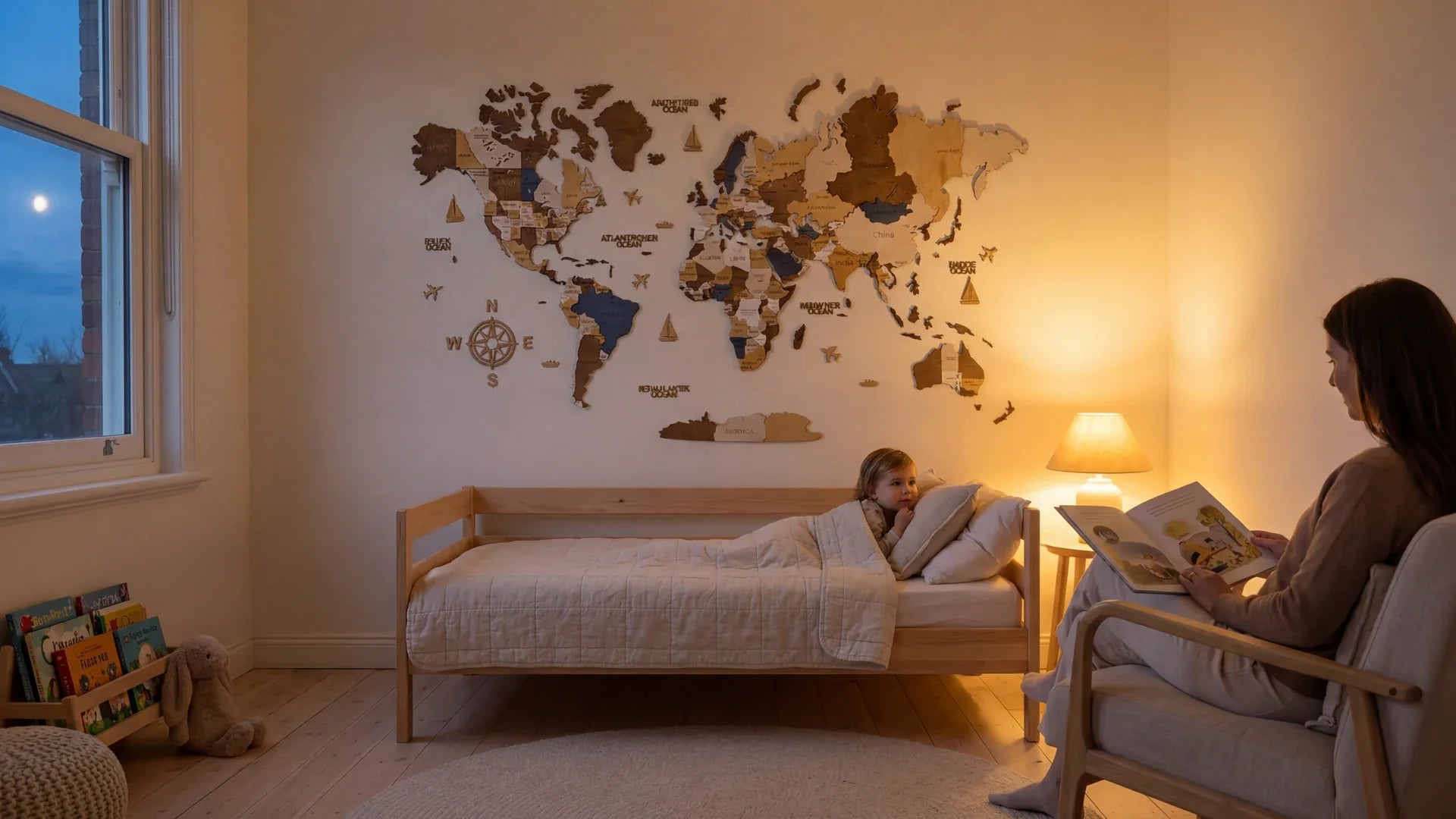
The lamp matters as much as the window. Most bedroom evenings happen under one warm bedside light, not daylight. Matte wood absorbs that light and stays soft. Glass and gloss bounce it straight into your eyes. Choose for the lamp you actually read by, not for the showroom.
Finish and Colour for a Calm Room
For most bedrooms, Dark Brown is the safe and quiet default. The espresso-stained birch reads warm above a headboard, sits with oak and walnut furniture, and disappears politely into a deep wall colour instead of fighting it. If your room is built around dark linen, a panelled wall, or a wooden bed frame, this is the one.

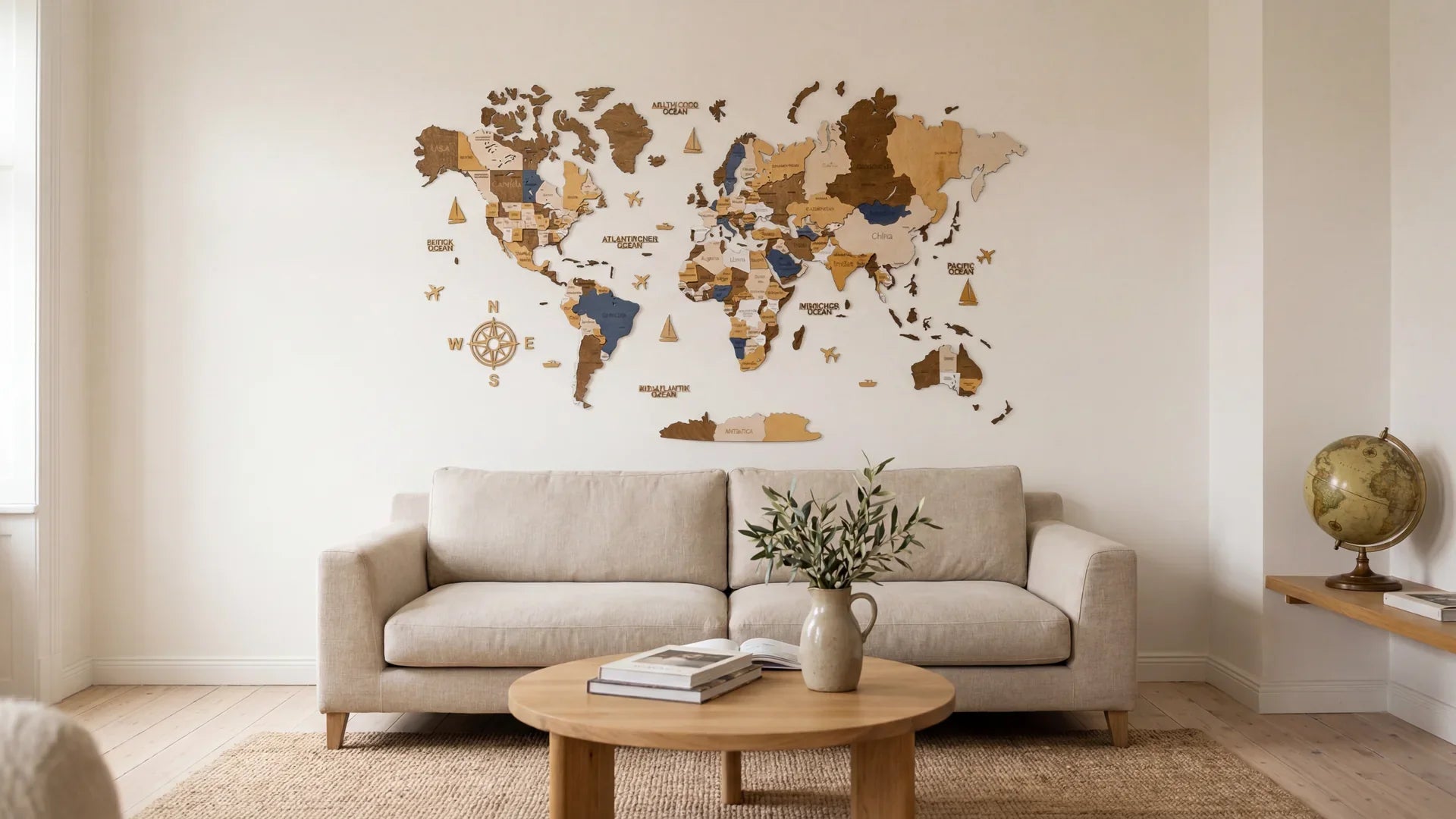
Natural Wood is for the lighter room: pale plaster, white or oatmeal linen, oak floors, the Scandinavian register. Here the pale birch belongs to the same family as the rest of the room and keeps everything soft and bright. It is the better choice in a north-facing or genuinely small bedroom, where a dark piece would only press the walls inward.

Multicolor is the exception, not the default. Its five earth tones are graphic and a little bright for a room meant for sleep, so keep it out of the primary bedroom. It earns its place in a teenager's room or a guest room you also use as a study. If you want the map but want it calm, look at the Dark Brown finish first.
Small Bedrooms and Rented Flats: No-Drill, Damage-Free
European bedrooms are often the smallest room in the flat, and a large share of them are rented. Both facts point the same way: you want presence on the wall without holes in it.

The map mounts with acrylic adhesive dots and no drilling, so it goes up on plaster, painted walls, and most rented surfaces without a single hole. In a small bedroom that also keeps the piece flat to the wall, which a deep frame on a hook never quite manages. The full method is in the no-drill mounting guide. And because it ships as many small wooden parts, anything that goes missing in a move or a re-hang is covered by lifetime replacement of small parts, so a relocated map does not become a half-finished one.
One small-room note. In a tight bedroom the bed often sits centred on the longest wall, which makes that wall the obvious and usually only place for a single piece. Resist the urge to also dress the side walls. One calm anchor and quiet around it is what makes a small room feel larger, not more objects.
The Mistakes We See Most
Four come up again and again.
- Too small. A 40 or 50 cm piece above a 150 cm headboard. It floats, the wall reads empty, and the bed looks unfinished. Size to two-thirds of the headboard, as a floor not a ceiling.
- Too high. Hung at living-room height, 35 cm or more above the headboard. The bed and the piece stop reading as one thing and a band of dead wall opens up between them. Drop it to a 15 to 20 cm gap.
- Too busy. A grid of frames, a shelf of objects, a gallery imported from someone's living room. It gives a sleeping room a dozen things to scan. One piece, or none.
- Headboard mismatch. Centring the piece on the wall instead of on the bed, so it sits off to one side of where you actually lie. Centre on the headboard every time, even if that leaves the wall itself looking slightly asymmetric. The eye reads the bed, not the plaster.


A Small Observation
The wall above your bed is the last thing you see at night and the first in the morning, and you will look at it more times than any other surface you own. Most people never choose it at all. It just stays blank, or holds whatever was left by the people before.
Give it one calm thing, sized right and hung low, and the room stops asking you for anything. You notice it most on the mornings the light comes in and finds it already settled.
Frequently Asked Questions
What should I hang on my bedroom wall?
How big should art be above a bed?
How high should you hang decor above a bed?
Should the wall above the bed be empty?
Is it OK to hang a world map above a bed?
Related reading
- Calm bedroom wall ideas and a cosy mood
- How to decorate a teen bedroom: practical wall ideas
- The complete guide to living room wall decor
- All WOW WOOD wooden world maps, the full collection
The full WOW WOOD range lives at wow-wood.eu/collections/wooden-world-maps: three finishes, three sizes, eight languages. Measure the headboard first. Then choose.
Written by the WOW WOOD editorial team. We've helped European households style their walls since 2022.



Share: