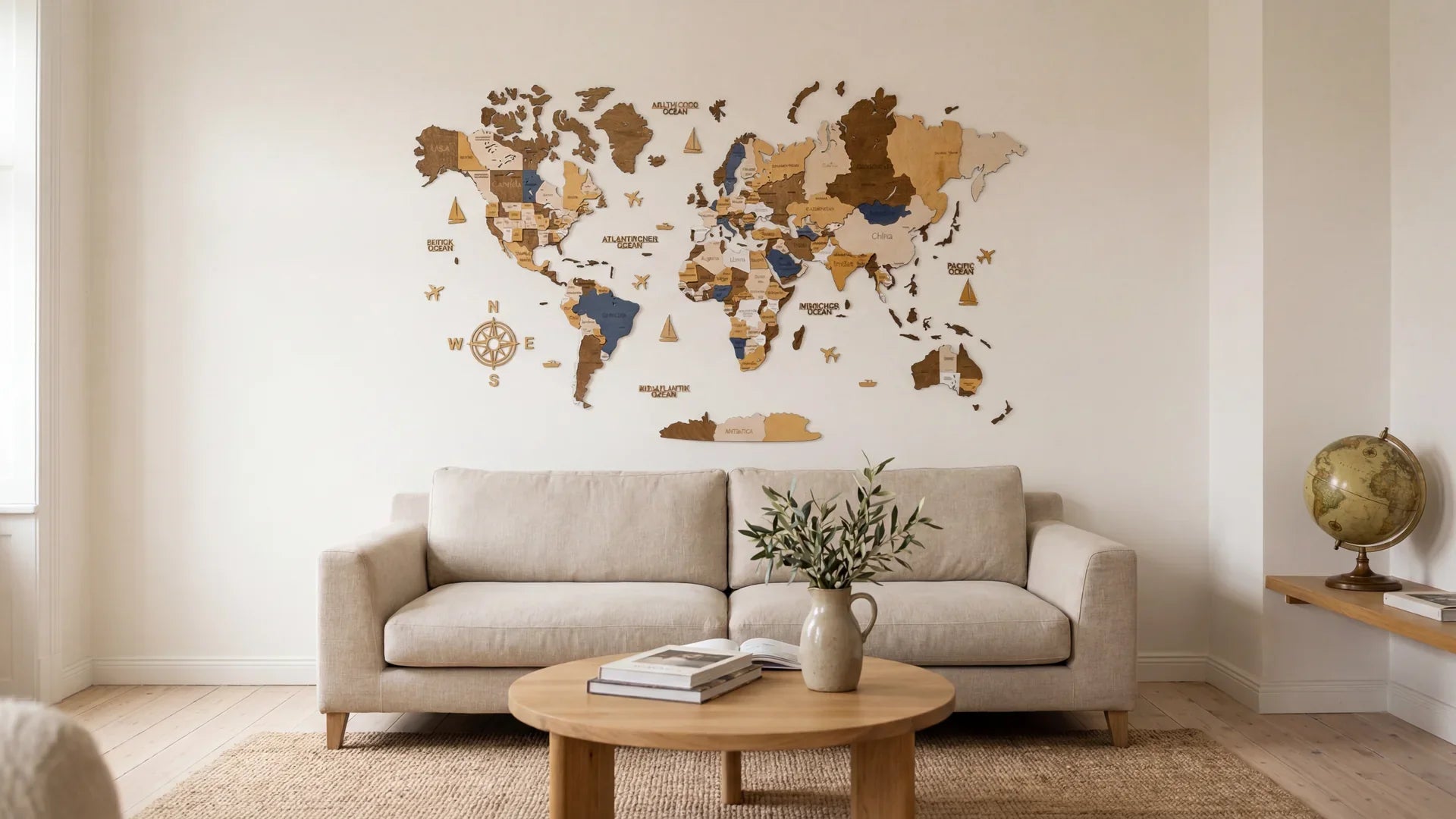
Average sofa width in Europe sits around 220 cm. Recommended wall-decor width is two-thirds of that. So: roughly 145 cm. WOW WOOD's L-size 3D wooden world map (160 × 85 cm, €229) sits at the upper edge of that range — and this guide explains what to do with that 145 cm, and why most people get it wrong by going smaller.
Why this matters
A blank wall above a sofa carries more weight than most people realise. It is the surface you see when you sit down. Get it wrong and the room never settles. Get it right and the eye stops searching.
This guide is for European living rooms — smaller than American ones, often with plaster walls and limited natural light. It treats the 3D wooden world map as one option among several, not the only answer.
The Living Room Wall: Why It Matters More Than the Sofa
People spend months choosing a sofa. They visit showrooms, sit on cushions, compare fabrics. Then they hang a 60 cm framed print above it and call the room finished.
The wall behind a sofa is the largest visual surface in the room. It frames the sofa rather than the other way around. A great sofa under a wrong wall reads as incomplete. A modest sofa under a strong wall reads as considered.
Light pattern matters here. Most European living rooms are lit by one window — sometimes two. That window sets the direction of light across the wall.
In Northern Europe, low winter sun moves across the wall horizontally for hours. In Southern Europe, vertical midday light flattens the surface.
The wall above the sofa absorbs and reflects this light differently depending on its texture, colour, and what hangs on it. A flat surface — painted plaster, vinyl decal, thin canvas — reads as background. A textured surface — 4 mm birch plywood with shadow gaps between continents, a heavy linen weave, an oak panel — reads as object.
The room with object reads as finished. The room with background reads as in-progress.
This is the case Ilse Crawford makes throughout her work. The British designer and founder of Studioilse, writing in The Sensual Home (Quadrille, 1997), describes the home as made through the things it contains — not many, but each chosen with intention. A wall behind the sofa is the most-looked-at chosen-thing in the room. It rewards attention given at the front end.
The Two-Thirds Rule (And When to Break It)
The two-thirds rule comes from gallery curation. A piece of wall decor mounted above furniture should occupy roughly two-thirds of the furniture's width. Architectural Digest's guide to hanging art above a sofa names the same proportion, as does Apartment Therapy's hanging-height reference. The principle traces back to gallery practice — described in Tom Wolfe's The Painted Word (1975) and codified in museum hanging manuals since.
For a 220 cm sofa, two-thirds is around 145 cm. For a 180 cm two-seater, around 120 cm. For a 240 cm corner sofa, around 160 cm.
How big should wall decor be above a sofa?
The piece should be between 60% and 75% of the sofa's width. Smaller than 60% and the wall reads as empty; the piece floats. Larger than 75% and the piece overwhelms the sofa.
A 220 cm sofa wants a piece between 130 cm and 165 cm wide. WOW WOOD's L size (160 × 85 cm) sits at the upper edge of that range and is the bestseller for living room walls. The M size (120 × 65 cm) suits sofas between 160 cm and 200 cm — common in studio apartments and one-bedroom flats. The XL (213 × 113 cm) is for long walls and corner sofas wider than 240 cm.

How high should wall decor be hung?
The bottom edge should sit 15 to 25 cm above the sofa's backrest. Not more. The eye reads decor and sofa as a single composition when the gap is small. When the gap exceeds 30 cm, the two read as separate, and the wall above the decor starts to feel empty again.
When to break the rule
Three situations:
- Ceiling height over 3 m. With taller walls, a piece sized to two-thirds of the sofa looks small. Size to two-thirds of the wall height instead.
- A strong feature already on the wall — fireplace, structural beam, tall window. The piece should be smaller, closer to half the sofa width.
- A single tall narrow piece. Vertical pieces follow a different rule: match the sofa's height-from-floor, not its width.
At a glance — WOW WOOD wooden world map specs
Includes 297 wooden pins · acrylic adhesive dots · illustrated installation guide in 8 languages · premium gift packaging · free EU shipping · lifetime replacement of small parts.
What Goes Above the Sofa: Five Categories
What should I put on my living room wall?
The five categories most living rooms draw from:
- A single large object — a wooden world map, a framed photograph, an abstract painting, a woven hanging.
- A pair — two pieces of equal weight, side by side or stacked.
- A grouped triplet — three pieces of varying size, balanced.
- A gallery wall — five or more pieces in a planned arrangement.
- Nothing — a deliberately empty wall, painted in a strong colour.
Each works. The choice depends on the room's existing complexity. A busy room with a patterned rug, layered textiles, and many objects asks for a single piece — anything more crowds it. A spare room with a plain rug and minimal furniture can hold a gallery wall.
WOW WOOD's 3D wooden world maps fall in category one. They anchor a sofa without crowding the rest of the room. The Natural Wood finish reads as material rather than image.
The Dark Brown reads as graphic object. The Multicolor reads closer to a painting than to a map.
One Large Piece vs Gallery Wall: How to Choose
Is one big piece or a gallery wall better?
For most living rooms — one big piece.
The gallery wall had its decade. Pinterest documented it extensively through the 2010s; design publications named it a defining interior pattern around 2017 and 2018. Since 2021, the same publications have been tracking its retreat in favour of single, well-chosen objects.
The reason is practical. Gallery walls demand coordination — frame consistency, spacing, the balance of dark and light — that most homes cannot sustain over time.
Pieces change. Frames break. The wall starts to look like a record of intentions rather than a finished composition.
A single piece needs only itself.
A gallery wall is right when:
- The room is otherwise spare and needs visual density
- You have a coherent collection — botanical prints, family photographs, abstract paintings in matched frames
- You are willing to redesign it every few years as pieces change
A single large piece is right when:
- The room is already textured — patterned rug, plants, layered fabrics
- You want to commit to one decision rather than ten
- You want the wall to read as finished from across the room, not from close inspection
The 3D wooden world map sits in the second category. It is a single decision. It commits.
Material Matters: Wood, Canvas, Print, Textile, Mirror
Material decides how the wall reads from distance and how it ages.
Canvas reads as flat. From across a room, printed canvas looks like wallpaper. It works at close range — entryways, stairwells. Less so in living rooms, which are seen mostly from the sofa.
Vinyl decals read as temporary. Useful for renters who cannot drill walls. Not a permanent answer.
Print on paper reads as image. A single framed print above a sofa often feels under-scaled unless the frame is heavy and the mat is wide.
Textile — woven hangings, large linen panels — reads as soft. Adds acoustic dampening, useful in rooms with hardwood floors and high ceilings.
Mirror reads as light. A large mirror behind a sofa doubles the apparent window light, helpful in north-facing rooms. The downside: it reflects whatever the eye least wants to see.
Wood — specifically birch plywood — reads as object. The 4 mm layered structure creates shadow gaps between continents, visible from across the room.
The material is matte rather than glossy. From six metres away, it still reads as three-dimensional.
WOW WOOD uses 4 mm Baltic birch plywood, handcrafted in Europe, laser-cut and finished with clear oil (Natural Wood), pigment stain (Dark Brown), or layered colour application (Multicolor). All three finishes preserve the wood's depth.


Above the TV: The Hardest Wall to Get Right
What goes above the TV?
The wall above a television is the hardest decoration challenge in a living room. The TV is already a dominant visual object — a 65-inch screen occupies roughly 145 cm of wall width. Anything above it competes for attention.
Three rules:
- The piece should be smaller than the TV. Roughly 75% of the TV's width.
- It should sit at least 25 cm above the TV's top edge.
- It should be visually quieter than the TV — lower in saturation and contrast.
A 3D wooden world map in Natural Wood works above a TV because the wood tones are low-contrast. The Dark Brown works similarly. The Multicolor competes with the TV — not recommended for this placement.

An alternative: leave the wall above the TV empty. Paint it a darker shade than the rest of the room — the dark recess frames the TV.
The Long Wall: What to Do with Horizontal Space
European living rooms often have one long wall — four to five metres of uninterrupted plaster. The two-thirds rule does not scale here. A 300 cm piece above a 220 cm sofa overwhelms.
Two approaches. Anchor with one large piece centred on the sofa, leave the rest empty. Or add a second smaller element to the side — a sconce, a small framed photograph, a wall-mounted bookshelf.

The XL 3D wooden world map (213 × 113 cm) is sized for long walls. For walls longer than 4 m, two L-size maps spaced 50 cm apart read as a deliberate pair.
Open-Plan Living Rooms: Decor Without Clutter
Open-plan apartments compound the wall-decor problem. Without a wall dividing kitchen from living room, every visible surface competes. Hang too many objects across all the walls and the apartment reads as restless.
The rule for open-plan: one strong visual anchor per zone. The living room gets one large piece. The kitchen wall stays mostly empty — a shelf, a clock, no more. The dining area can hold a second piece if it is clearly differentiated from the first — different scale, different orientation.
A wooden world map in an open-plan apartment works well above the sofa because it visually defines the living zone without needing a physical wall. The eye reads "this is the living area" because the map anchors it.

The no-drill installation — acrylic adhesive dots, no holes — matters here too. Open-plan apartments are often rented.
Light Direction: How Daylight Changes the Wall
Most living rooms in Europe have one main light source: a single window. The window's compass direction shapes how wall decor reads through the day.
North-facing windows — common across Scandinavia and the UK — produce cool, diffuse, soft light. Dark colours can disappear into the shadow; light woods and pale colours read more clearly.
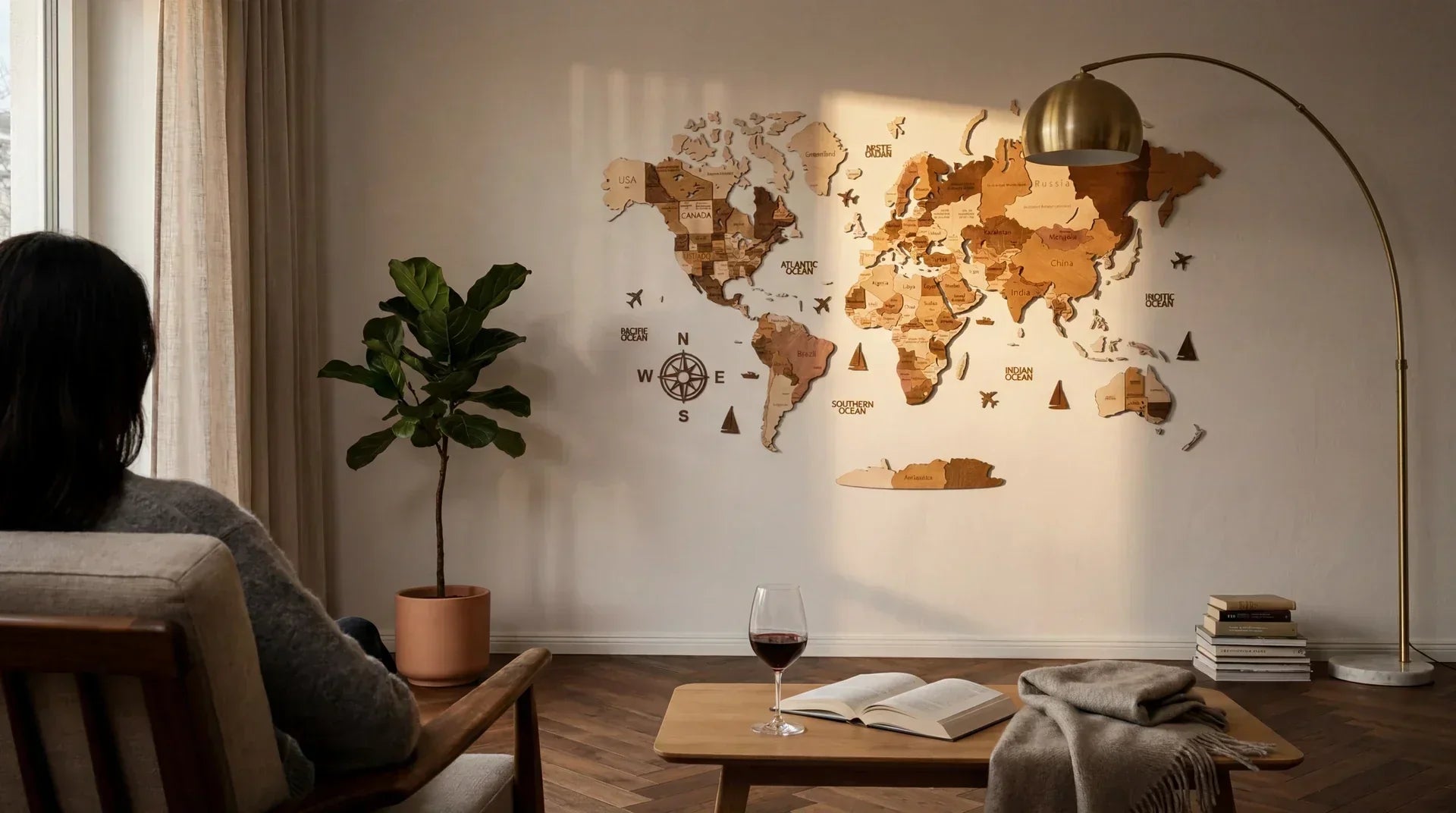
South-facing windows — much of Spain, southern Italy, Provence — produce hot, direct light. Direct sun ages wood: UV exposure darkens birch over years. Position the map on the wall opposite the window, not adjacent to it.
East and west windows produce angled morning or evening light. The shadow gaps between continents change with the angle of the sun.
Three Styles, Three Approaches
Scandinavian: pale plaster, oak floors, linen sofas, plants. The wall asks for restraint. A single object, low-contrast, made of natural material.
Natural Wood finish, L or XL size. The map sits inside the tradition of clear-finished birch and oiled oak.
Mediterranean: warm white walls, terracotta tones, dark wood furniture, perhaps an exposed beam ceiling. The room can hold more visual weight than a Scandinavian one. Dark Brown finish works here — the rich tone sits with terracotta and timber. The map can be larger relative to the sofa.
Industrial / urban: exposed brick or concrete, leather sofas, black metal frames, bold lighting. The room reads as graphic and hard. Multicolor finish — or Dark Brown on a brick wall — gives counterpoint to the rough surfaces. Plywood's softness humanises an otherwise hard room.
The map functions differently in each style. In Scandinavian rooms it disappears into the room's calm. In Mediterranean rooms it adds depth to warmth. In industrial rooms it softens hardness.


The Mistakes We See Most Often
Five recurring problems:
- The undersized piece. A 60 cm frame above a 220 cm sofa. The most common mistake. The piece floats; the wall reads empty. Correction: size to two-thirds of the sofa width, minimum.
- The over-hung piece. Bottom edge 40 cm or more above the sofa back. The wall above the decor becomes dead space. Correction: 15 to 25 cm gap, no more.
- The off-centre piece. A piece hung over one armrest rather than centred on the sofa. Often happens when the sofa shifted but the decor did not. Correction: re-centre on the sofa, not on the wall.
- A gallery wall in an already-busy room. Patterned rug, patterned curtains, gallery wall — three layers of complexity competing. The room reads as anxious. Correction: choose one layer of pattern, simplify the rest.
- The temporary piece that lasted four years. A small print that was "good enough for now" becomes the permanent answer because the next decision feels hard. Correction: leave the wall empty rather than commit to a piece that does not fit.
A Step-by-Step: From Bare Wall to Final Piece
- Sit on your sofa. Take a photograph of the wall behind you — phone camera, eye-level.
- Measure the sofa. Width edge to edge. Multiply by 0.67. This is your target piece width.
- Measure the wall. Confirm space for a piece at your target width with at least 30 cm clearance on each side.
- Choose category. Single piece, pair, triplet, gallery, or empty. Most living rooms work best with single piece.
- Choose material. Wood reads from distance — strongest for living rooms.
- Mock it up before buying. Cut a paper template to the size of the piece. Tape it to the wall. Live with the silhouette for two days.
- Mount it correctly. Bottom edge 15 to 25 cm above the sofa back. Centred on the sofa, not on the wall.
- Wait a week before deciding it is done. If it bothers you after a week, the size or position is probably wrong.
A small observation
The wall behind the sofa is the surface you see for thousands of evenings. Most people choose what hangs on it in a single afternoon. The mismatch shows.
A piece chosen with care does what a window does: it gives the eye somewhere to rest.
Frequently Asked Questions
How big should wall decor be above a sofa?
How high should wall decor be hung above a sofa?
What should I put on my living room wall above the sofa?
Is one big piece or a gallery wall better for the living room?
What goes above the TV?
What size wooden world map is right for my living room?
Can I hang a wooden world map without drilling holes?
Related reading
- WOW WOOD Natural Wood 3D wooden world map — product details
- WOW WOOD Dark Brown 3D wooden world map — for classic and Mediterranean interiors
- WOW WOOD Multicolor 3D wooden world map — statement finish
- All WOW WOOD wooden world maps — the full collection
The WOW WOOD Living Room collection lives at wow-wood.eu/collections/wooden-world-maps — three finishes, three sizes, eight languages. The Natural Wood finish sits inside the Scandinavian tradition; Dark Brown anchors Mediterranean rooms; Multicolor reads as focal point in darker spaces.
Sit on your sofa first. Measure the wall behind you. Then choose.
Written by the WOW WOOD editorial team. We've helped European households style their living-room walls since 2022.


Share: