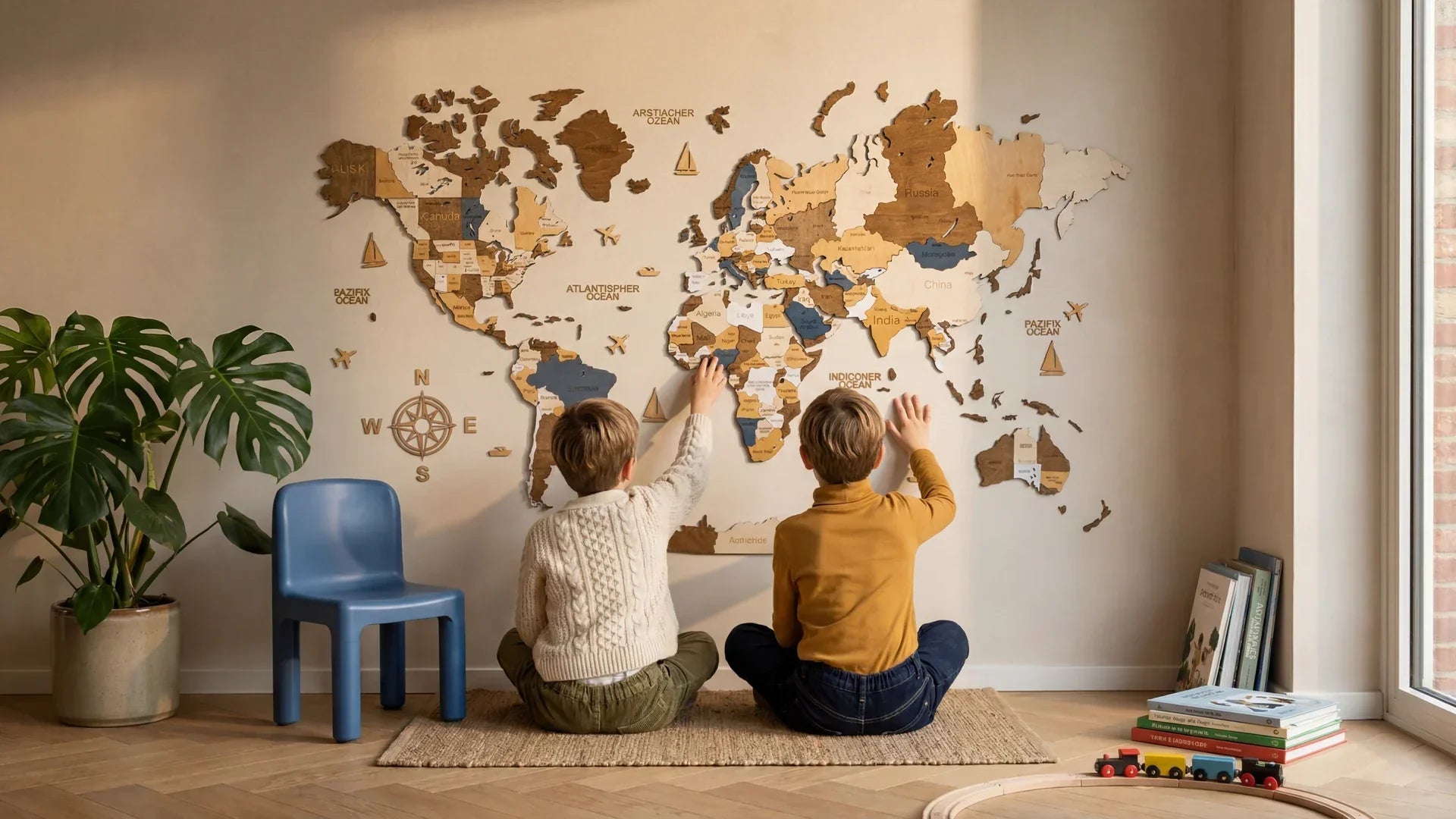
You don't need an educational toy for the wall. You need one object your child can touch — at her height — every day for years. A world map mounted at child level does what most decor for children doesn't: it gets more interesting as she grows, not less.
A world map in a child's room is one of the few decor pieces that holds attention from age two through adolescence. The key is mounting height — the lower edge should sit at the child's eye level, around 80 cm from the floor for a four-year-old. WOW WOOD's Multicolor wooden world map — five earth tones, 297 pins, 4 mm birch plywood — is the finish most often chosen for kids' room world map decor.
Why this matters
Most parenting advice about wall decor is either decorative or developmental, rarely both. The decorating magazines tell you which palette to pick. The Montessori books describe what a prepared environment should feel like. Neither answers the question parents actually ask: which object goes on the wall, at what height, and what does the child do with it.
This guide answers that. It covers age stages from late toddlerhood through pre-adolescence, the mounting heights that match a child's eye level, the finish that works best in a small room, and an honest safety conversation about pins. It treats the world map as part of the prepared environment — a quiet object that rewards repeated attention.
What this guide covers
- What a wall map teaches at each age
- The right age to introduce one
- Mounting height by age (table)
- Choosing the finish for a child's room
- Sizing the map to the room
- The Montessori case for maps on the wall
- Pins, touching, and under-3 safety
- Common mistakes parents make
- A year-by-year reading practice
What a Wall Map Actually Teaches a Child
A world map teaches scale before it teaches names. A two-year-old sees shapes and colours. A four-year-old recognises that Africa is much bigger than Spain. A six-year-old begins to attach country names to the shapes — usually starting with her own country, then the countries where her grandparents live, then the countries from picture books read aloud at bedtime. By eight, the map functions as a reference. She no longer asks where Japan is. She walks over and checks.
This is slower than a screen, and that is the point. Developmental psychologist Alison Gopnik at UC Berkeley has written about how young children build mental models through repeated, low-pressure exposure to objects in their environment. A wall map is exactly that — present every day, never demanding a response, available when curiosity arrives. See also why a world map shapes a child's sense of scale and curiosity.
The map also builds a place vocabulary. When your child hears "Vietnam" mentioned at dinner or in a story, she has somewhere to put the word — a specific spot on the wall above her desk, rather than a name floating untethered.
What can a child learn from a world map?
In the early years, your child learns that the world has a shape, that land and water are different, and that her room contains a representation of something far larger than itself. From age five or six, country names attach to the shapes — beginning with her own country, then countries where family lives. From age eight, the map becomes a tool she uses to check and compare. The lesson is cumulative.
The Right Age to Start: 18 Months to 12 Years
There is no minimum age, because the map doesn't ask the child to do anything. At eighteen months your child cannot read country names or grasp scale, but she can see shapes. She will look at the wall in her room hundreds of times before her second birthday.
Between three and five, the colours and outlines become genuinely interesting. She points and names continents in her own way — the green one, the long one. Between five and seven, names attach to shapes. By eight, she's reading them. By twelve, she may not look at it as often, but the spatial sense she built between two and eight stays.
The honest answer to parents who ask whether their child is too young: she isn't. The question is whether you are ready to mount it at her height rather than yours. For a fuller treatment of what age to introduce a world map to a child, see the dedicated cluster piece.
At what age should I introduce a world map to my child?
Anytime from eighteen months is appropriate. Younger than that, the child won't engage with detail at a distance, but the map causes no harm and begins to become part of the room's furniture. The most common starting age in Montessori-informed homes is between two and three. Deliberate use — finding countries, asking questions — emerges between five and seven.
Mounting Height: A Table by Age
Most parents make their first mistake here. They mount the map at adult eye level — 150 to 160 cm — because that is where adults hang wall art. A child cannot reach Greenland from there, cannot read the labels, and stops noticing the map within a month.
The lower edge should sit at the child's eye level or slightly below. As she grows, you re-mount — this is not the kind of decor you install once and forget. The no-drill acrylic adhesive dot installation makes re-mounting painless: no holes, no patching between mounts.

How high should I mount a world map for a child?
The heights below are for the lower edge of the map and assume average heights at each age. Adjust for your child's actual height — the rule is that the lower edge sits at her eye level or just below.
Re-mount every two to three years, or when the child has clearly outgrown the previous position. If she stops touching the map for a month, check whether she's grown past it.
Choosing the Finish: Natural, Multicolor, or Dark Brown for a Child's Room
WOW WOOD — a European brand handcrafting its maps from 4 mm birch plywood — ships three finishes. The right choice depends less on adult aesthetics than on what the child will do with the object day to day.
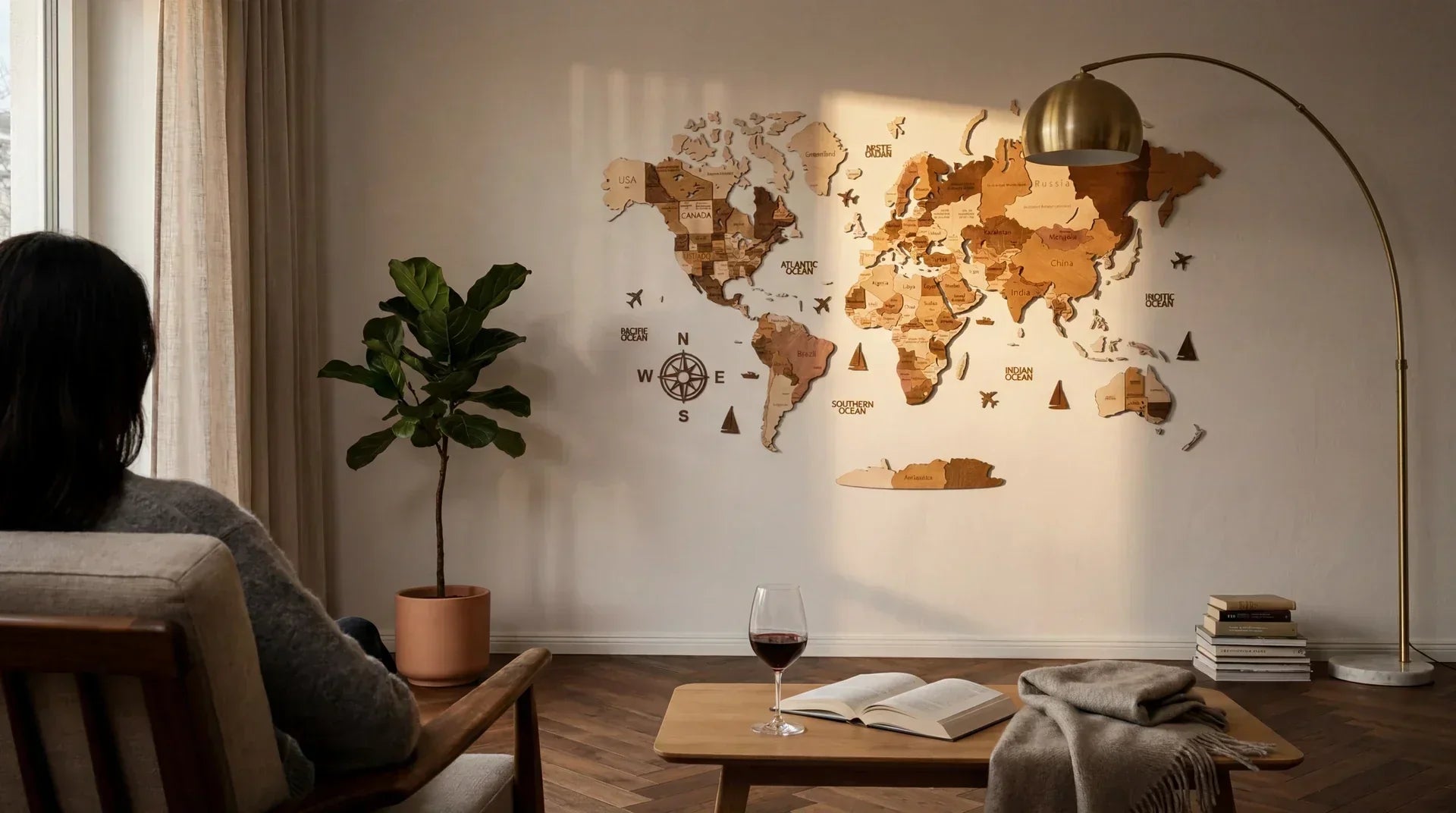
Multicolor is the most chosen finish for kids' rooms. Five earth tones — sand, terracotta, sage, ochre, slate — separate the continents visually, helping a younger child distinguish before she can read names. The Multicolor wooden world map is the variant most parents choose specifically for a child.
Natural birch is unstained, light, and quiet. It works well in nurseries and minimal rooms where you don't want the wall to compete with anything else. The trade-off: a younger child has to rely on shape alone to distinguish continents, which takes longer.
Dark Brown is the least chosen for children's rooms. It reads as a more adult finish — beautiful in a study or a teenager's room, but heavier than most parents want above a small child's bed.

The plywood is light enough that, if the map ever did detach from the wall, it would not injure a child standing below it.

Which world map is best for kids?
For most children between three and ten, the Multicolor finish in the L size (160 × 85 cm) is the standard recommendation. The colour-coded continents help younger children distinguish before they read. For rooms under 9 m², the M size is the better choice.
Size by Room: M, L, or XL
A wall map sized to a child's room follows different rules than one for a living room. The wall is shorter, the room smaller, and the map will be looked at mostly from close range — sitting on the bed, standing at the desk.
For a room under 9 m² (typical small nursery or shared-sibling half), the M size is correct. It hangs above a desk or low shelf without crowding. For a standard 10–14 m² child's room, the L size is the most common choice. For a larger room (15 m² and up), or for a teenager's room where the map needs to read as a statement piece, the XL size works — though this is a less common choice for younger children, because the scale can feel disproportionate to a small body.
A practical rule: the map's width should be roughly two-thirds of the wall it sits on. Measure the wall, multiply by 0.65. For most children's rooms, that lands you at L. For more detail, see what size wooden world map for a kids' room.
At a glance — WOW WOOD wooden world map sizes
Every map ships with 297 wooden pins, acrylic adhesive dots, and an illustrated installation guide in eight languages.


In Montessori practice we see three principles applied to the wall: order (one piece per wall, not many), accessibility (mounted at the child's height, not the adult's), and the absence of clutter (the wall around the map stays calm). A wooden world map satisfies all three when mounted with care. The cluster piece on Montessori wall decor principles goes deeper into the supporting environment around the map.
The map is also language-friendly. With eight language versions available, the country names on the wall can be in your child's first language — useful in bilingual households, and useful generally when the goal is for the child to read the names herself.
What to Do When the Child Touches Everything
Children touch wall maps. They run a finger along the coast of Africa, press a palm against the Atlantic, lift the pins out and put them back. This is not a problem to solve. It is the point.
A child of two — still putting small objects in her mouth — should not have access to the pins. The 297 wooden round-head pins are roughly 10 mm and child-safe certified for ages five and up. For children under three, store the pins separately — a small box on a high shelf, or kept aside until your child is older. The map goes on the wall now. The pins join later.
For children between three and five, the parent's judgement matters most. Some children at four are past the mouthing stage and can handle the pins under supervision. Others are not. Know your child and decide accordingly — and err toward storing the pins separately if you're unsure.
The 4 mm birch plywood map itself is safe at any age and will not injure your child if it detaches from the wall. The acrylic adhesive dots hold reliably on painted plasterboard, plaster, and most wallpapers — no drilling, no holes, no debris in a nursery.
Are wooden world maps safe for children?
The map is safe at any age — 4 mm birch plywood, no sharp edges, light enough that a fall would not cause injury. The pins are a separate question. The 297 wooden round-head pins are child-safe certified for ages five and up. For children under three, store the pins separately and add them to the map when your child is older.
Adding Pins: Family Geography, Travel Memories, Curiosity Triggers
The pins turn the map from a static object into something the family adds to over time. Three uses cover most of what parents do with them.

Family geography. Mark where each family member was born, where grandparents live, where cousins are. For a child whose grandmother lives in Spain and whose great-uncle lives in Brazil, the pins make those distances visible. The conversation that follows — why does Oma live so far away — is the conversation we want.
Travel memories. A pin for every country the family has visited together. This is slower than parents expect; most families add one or two pins per year, sometimes none. The map should reflect actual life, not a checklist.
Curiosity triggers. A pin in a country the child has heard about and wants to remember. After hearing about Madagascar in a book, your child may ask for a pin there. This is the map working as it should — the child is now using the wall to track her own attention.
Do the pin-placing together, especially in the early years. The act of choosing where the pin goes, finding the country, and pressing it into place is the moment the geography becomes hers.
The Common Mistakes: Mounting at Adult Height, Wrong Finish, Wrong Room
Three mistakes account for most of the disappointments parents report.

Mounting at adult height. The most common. The map is hung at 150 cm because that is where adults hang things, and the child loses interest within a month. Re-mount at her eye level — peel, re-position, no holes.
Choosing Dark Brown for a young child's room. Dark Brown is a beautiful finish, but it reads as adult and reads heavy above a small bed. For children under ten, Multicolor or Natural almost always works better.
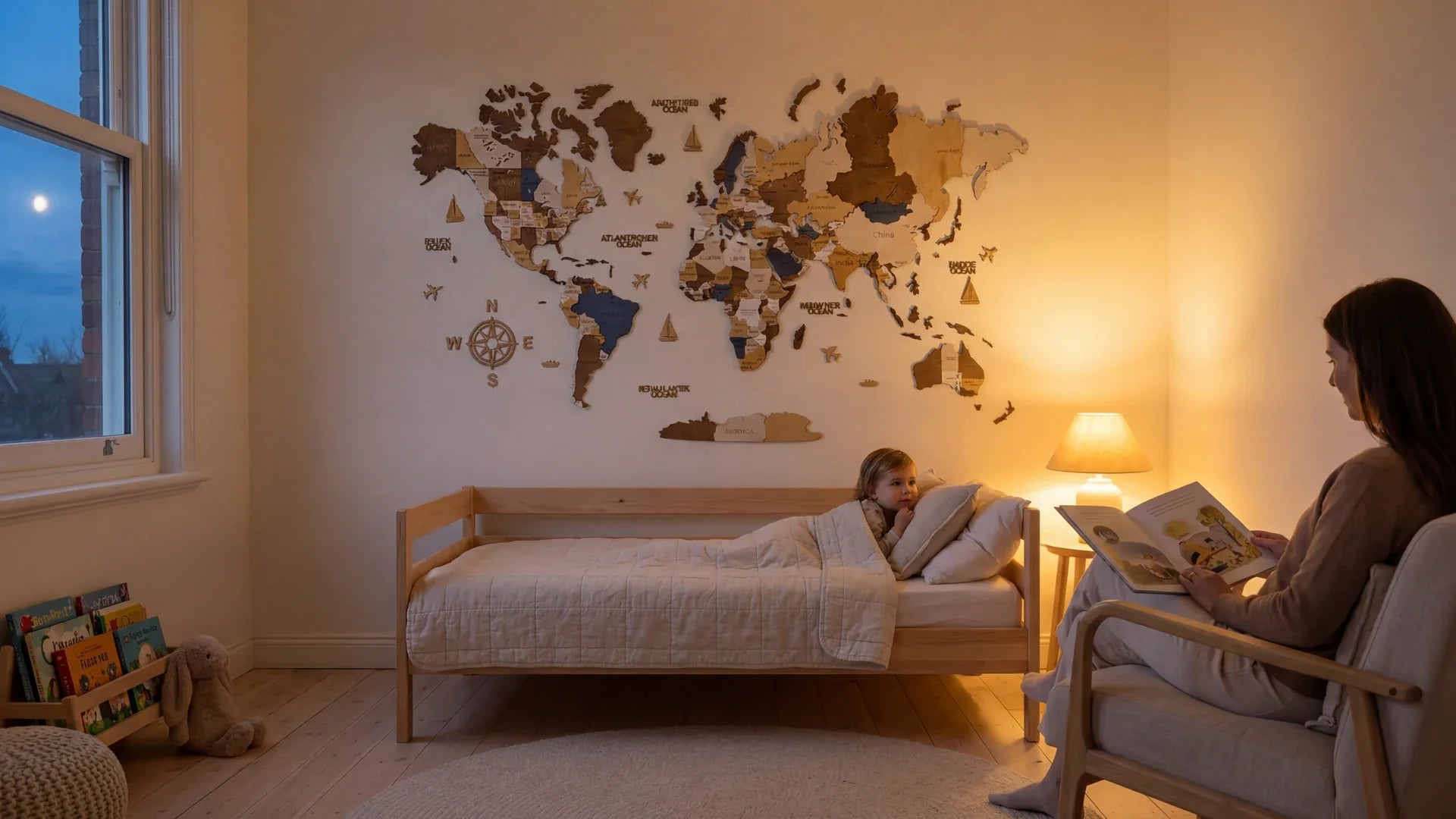
Wrong room. A wall map in a hallway your child rarely lingers in does little. The map belongs in the room where the child spends time — usually the bedroom, sometimes the playroom, occasionally the family room if that is where homework happens.
Reading the Map Together: A Year-By-Year Practice
The map works best when you build a small ritual around it. The ritual changes as the child grows.
Ages two to four. Once a week, sit with your child in front of the map and name the continents together. Trace outlines with your finger. Don't quiz. Name, point, move on.
Ages four to six. Begin to find specific places. Where does Oma live. Where is the country in the bedtime story. Where is your city. Keep it short — five minutes is plenty. Place one or two pins per month, no more.
Ages six to eight. The child starts to find places herself. Ask her to show you where Japan is. Let her be wrong, then look together. The map is now a reference she returns to, not a lesson you deliver.
Ages eight to ten. The map is now used without you. When she reads about a country or hears one in the news, she walks over and finds it. Your job is mostly to keep the pin supply stocked.
Ages ten and up. The map becomes background. She looks at it less often, but the spatial sense she built earlier remains. This is the right outcome.
Frequently Asked Questions
At what age should I introduce a world map to my child?
How high should I mount a world map for a child?
Which world map is best for kids?
Are wooden world maps safe for children?
What can a child learn from a world map?
A small action this week
If you already have the map, lower it. Most maps in children's rooms are mounted ten to thirty centimetres too high. Measure your child's eye level when she stands in front of the wall, mark a pencil line at that height, peel the map down, reposition it so the lower edge sits at the line, and press it back. Fifteen minutes. The change in how your child relates to the map will show within a week.
If you don't yet have one, the Multicolor finish in L is where most parents start. Mount it at her height. That's the part most parents get wrong.
Related reading
- Why a world map on your child's wall shapes curiosity and scale thinking
- What age is right to introduce a world map to your child
- Montessori-inspired wall decor: maps in the prepared environment
- What size wooden world map fits a kids' room best
- Further reading on early childhood environments: the Center on the Developing Child at Harvard publishes accessible summaries of the research on environment and early development.
Written by Margaux Lefèvre for the WOW WOOD editorial team. We've helped European households style their wooden world maps since 2018.

Share: