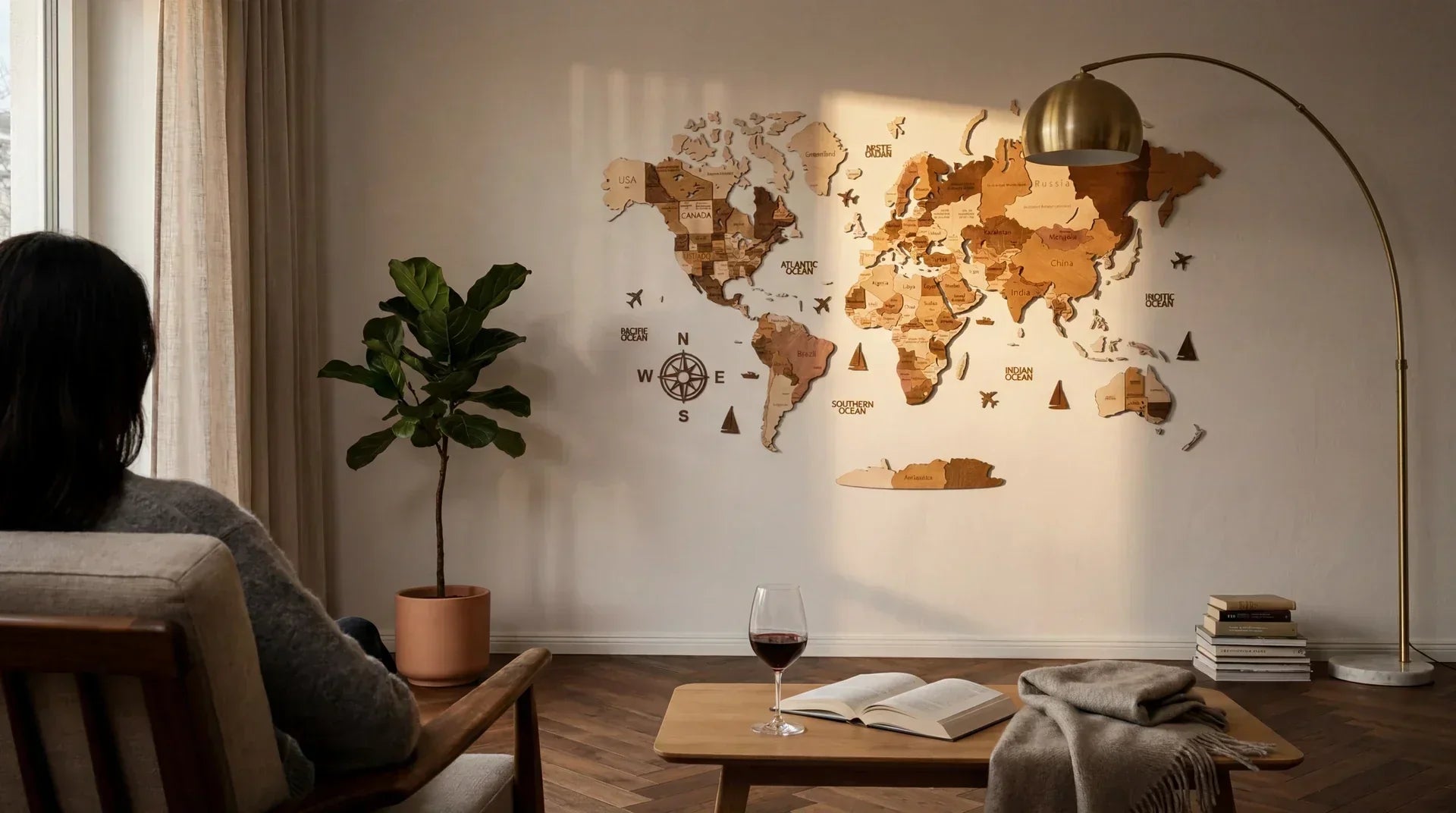
Why do travellers, specifically, hang maps on their walls? The answer isn't sentimentality. It's closer to identity — a quiet daily claim about who you are and where you've been.
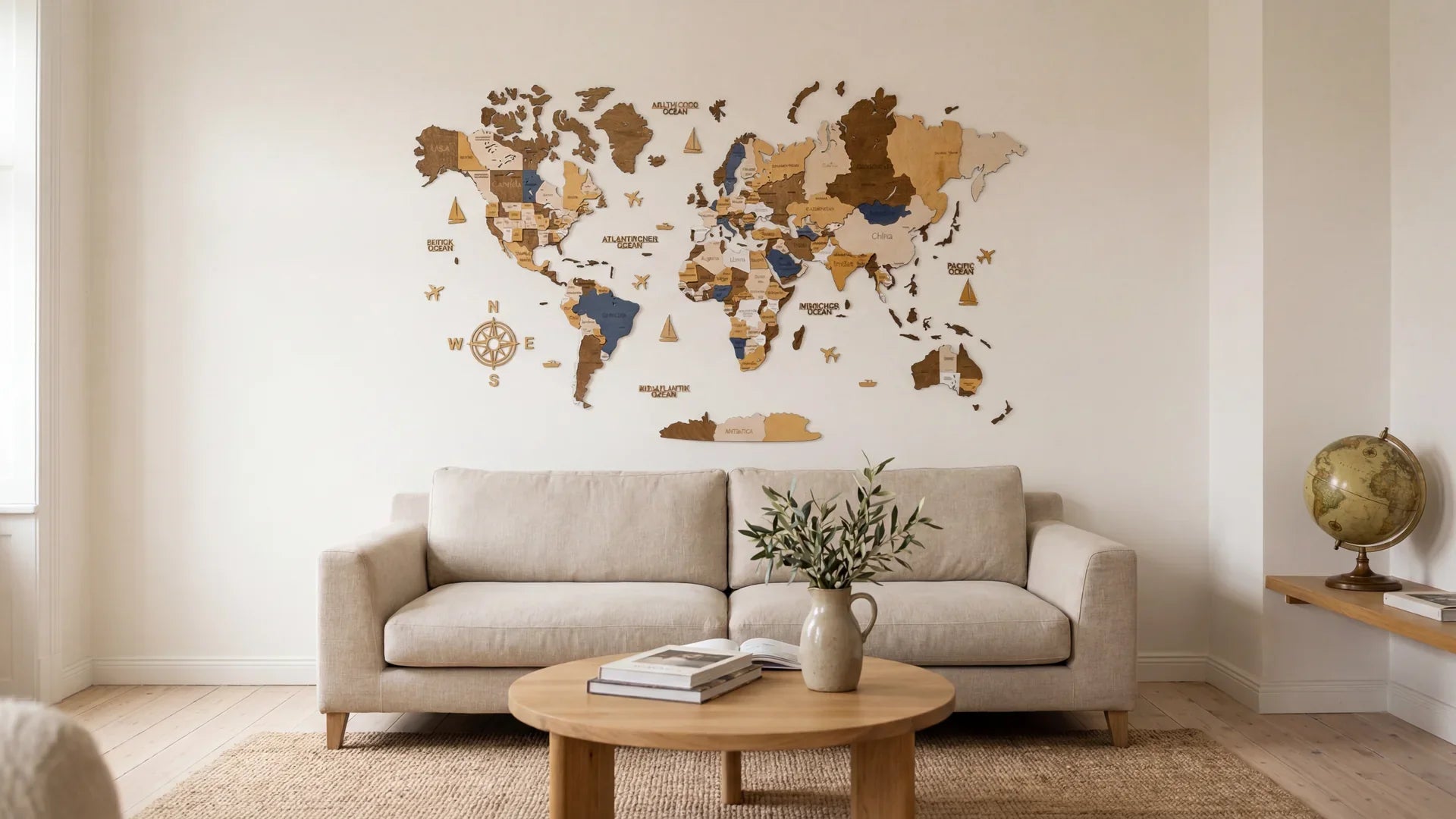
People hang travel maps to make their identity visible at home. A wall map turns abstract travel history into one physical object — a constant reminder of scale, distance, and personal geography. Wooden world maps such as the WOW WOOD 3D map (birch plywood, 297 pins, 4 mm thick) work because the wall can evolve over years rather than freeze a single moment.
The Identity Function: A Wall Map as Self-Portrait
A photograph of a trip says I went there. A wall map says this is the shape of how I move through the world. Different claim. The first is a record. The second is a declaration.
The environmental psychologists Leila Scannell and Robert Gifford, both at the University of Victoria, describe this in their 2010 paper Defining Place Attachment: people bond to places through person, process, and place itself — and the bond shows up in what they keep, display, and arrange at home. A map on a living-room wall is one of the cleanest examples. It's not the trip. It's the relationship the traveller has built with the idea of travelling.
The paper: Scannell & Gifford, Journal of Environmental Psychology 30(1), 1–10.
The Scale Function: Daily Encounter with the Size of the World
The second reason is practical. A wall map gives you a daily encounter with how large the world is — and how small your slice of it has been.
Most travellers, even active ones, have visited fewer than thirty countries. On a 160 × 85 cm map, thirty pins look modest. That's the point. The traveller is reminded, every morning over coffee, that there is more world than there is time. Travel-listicle culture inflates the sense that you've seen it all by thirty-five. A wall map flatly disagrees.
The Memory Function: A Place to Put What You've Done
The third reason is storage — not digital storage, the other kind. Phones hold photos no one revisits. A wall map is the opposite: a surface that holds the trips worth keeping and refuses the rest.

This is why pins matter. The rule of one pin per real trip — not per country, not per layover — emerges among long-term owners on its own. The wall edits for you. Lisbon in December, yes. The Frankfurt connection on the way back, no. That small repeated selection turns a map into a daily record rather than a poster.
The layered version of this practice — pins, paper, ticket stubs, photographs treated as one composition — is the subject of our pillar piece on building a travel memory wall.
Why Wooden Maps Amplify These Functions
The structural advantage is time. Paper fades in five to seven years. Canvas softens within ten. Birch plywood is a twenty-year medium, longer with care — and the three functions above only work if the surface outlasts the trips.
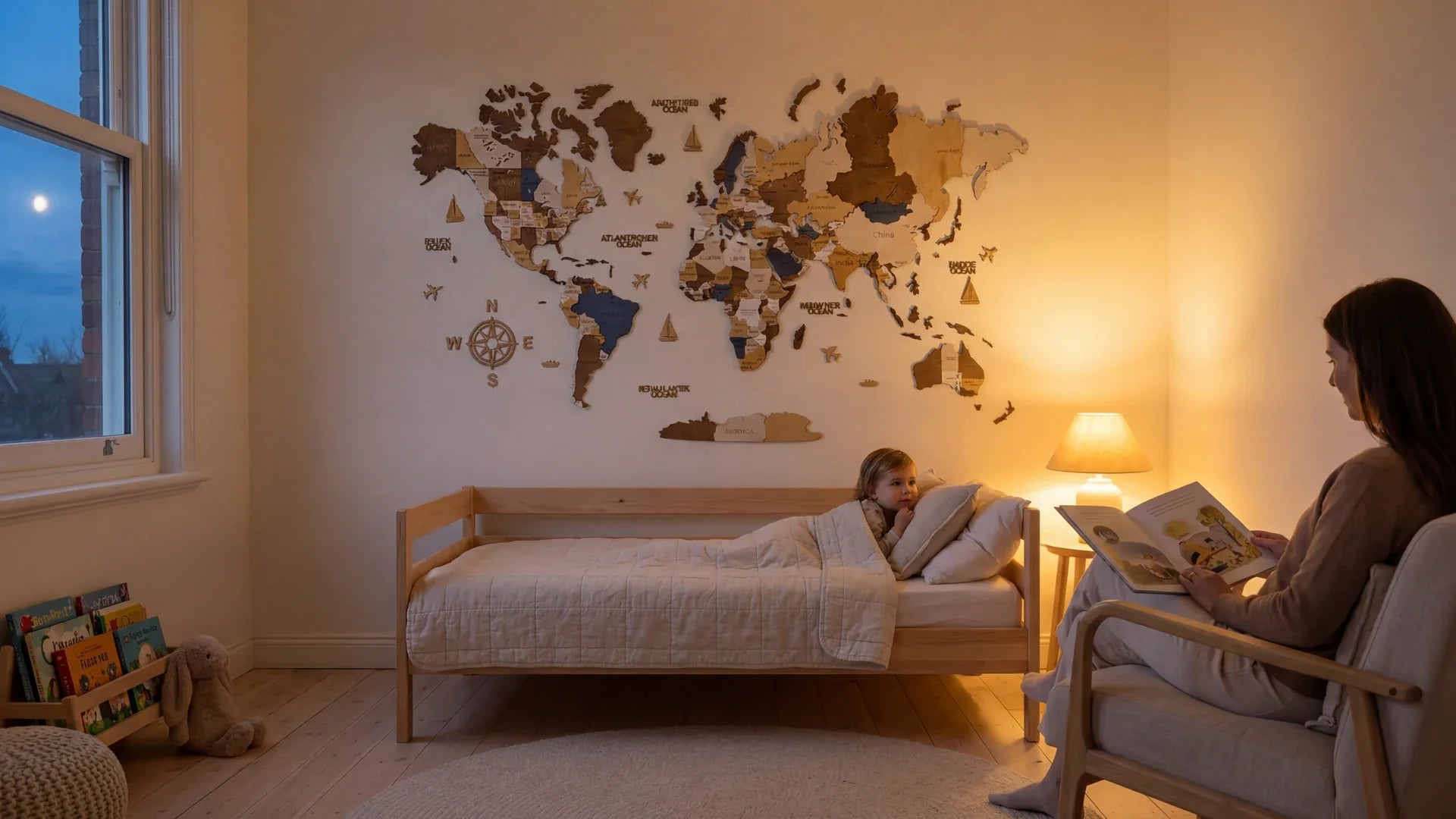
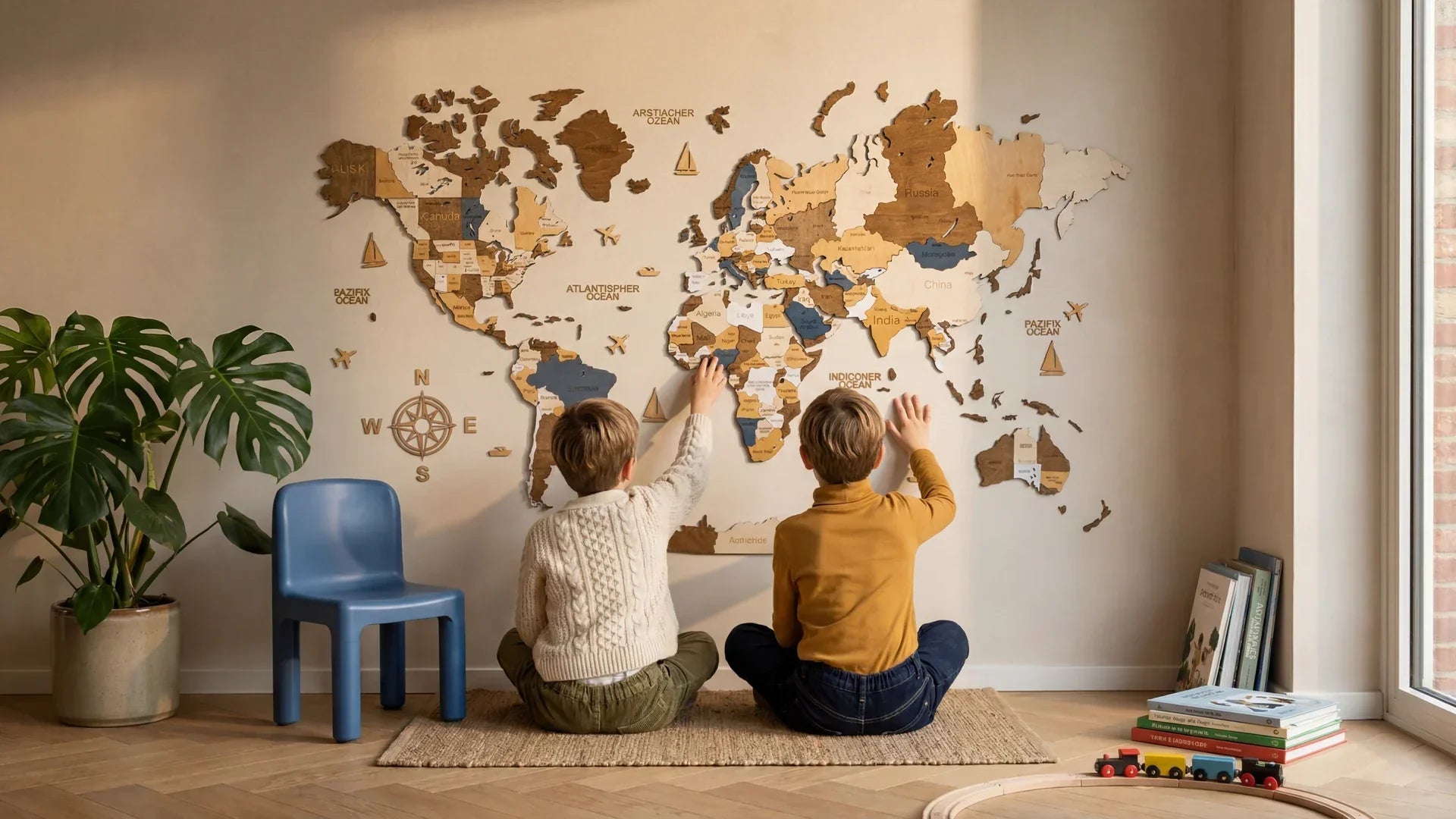
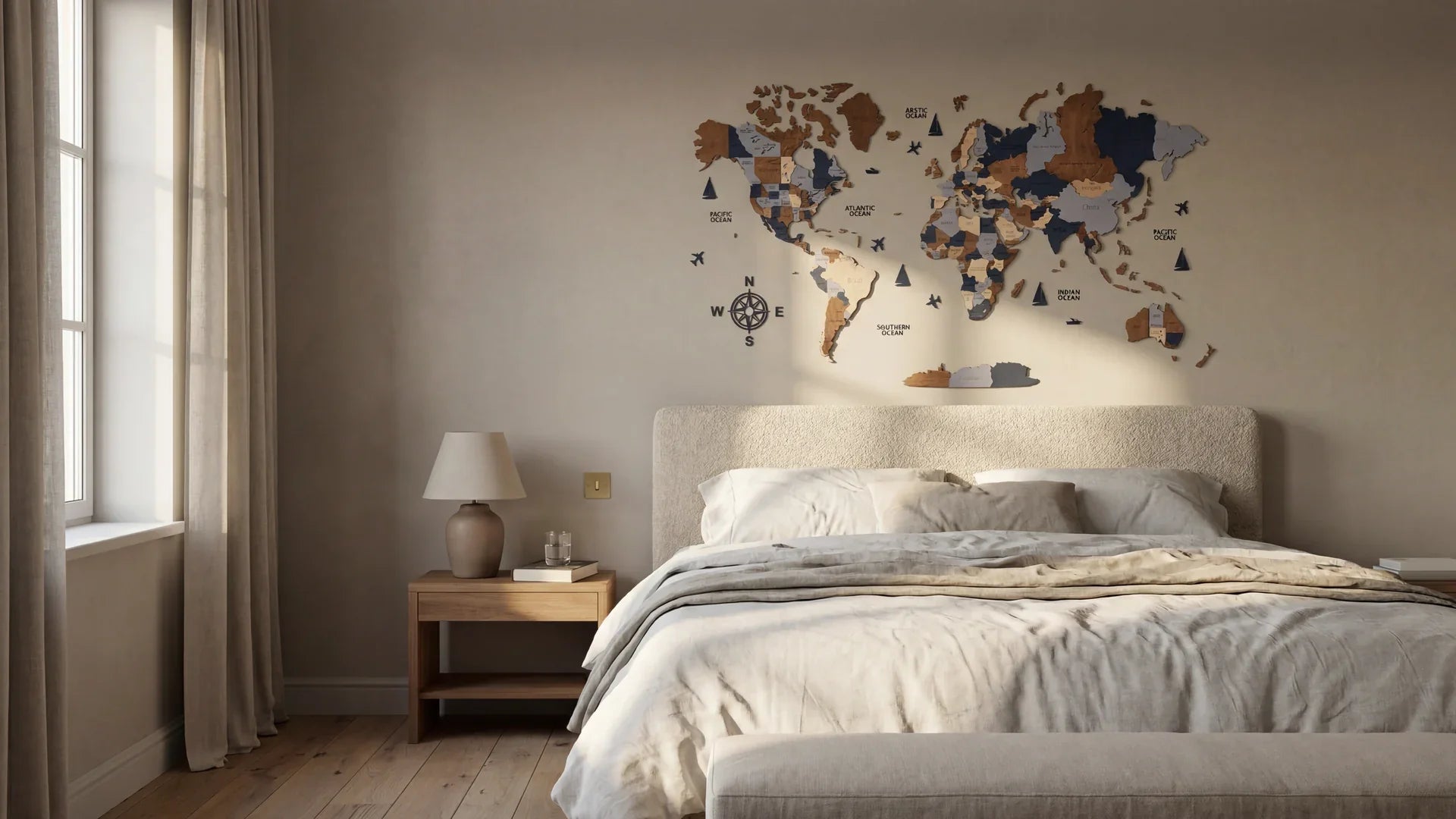
A WOW WOOD map (handcrafted in Europe, 4 mm birch plywood, 297 pin set, no-drill installation with acrylic adhesive dots, 8 language versions) gives the owner two decades of pin-additions without surface failure. The wall isn't frozen. The wall accumulates.

The Natural Wood map is the version that ages most visibly — the surface deepens, the pins stay. The full range sits at the wooden world maps collection. Why the eye returns to one object rather than many is covered separately in our cluster piece on the psychology of statement walls.
Frequently Asked Questions
Why do people put pins on travel maps?
Is it pretentious to hang a world map?
What does a map on the wall say about you?
A map on the wall isn't a trophy. It's closer to a self-portrait drawn slowly in pins.
If you've read this far, you already know which finish would suit your wall — and which version of yourself you'd be putting on it.

Share: