
The box has been sitting in the hallway for nine days. Inside: a folded paper menu from a tram-stop café in Lisbon, two ferry tickets from the Croatian coast, a small ceramic tile wrapped in a sock, and a receipt you kept for reasons you no longer remember. Above the box, the wall is still empty.
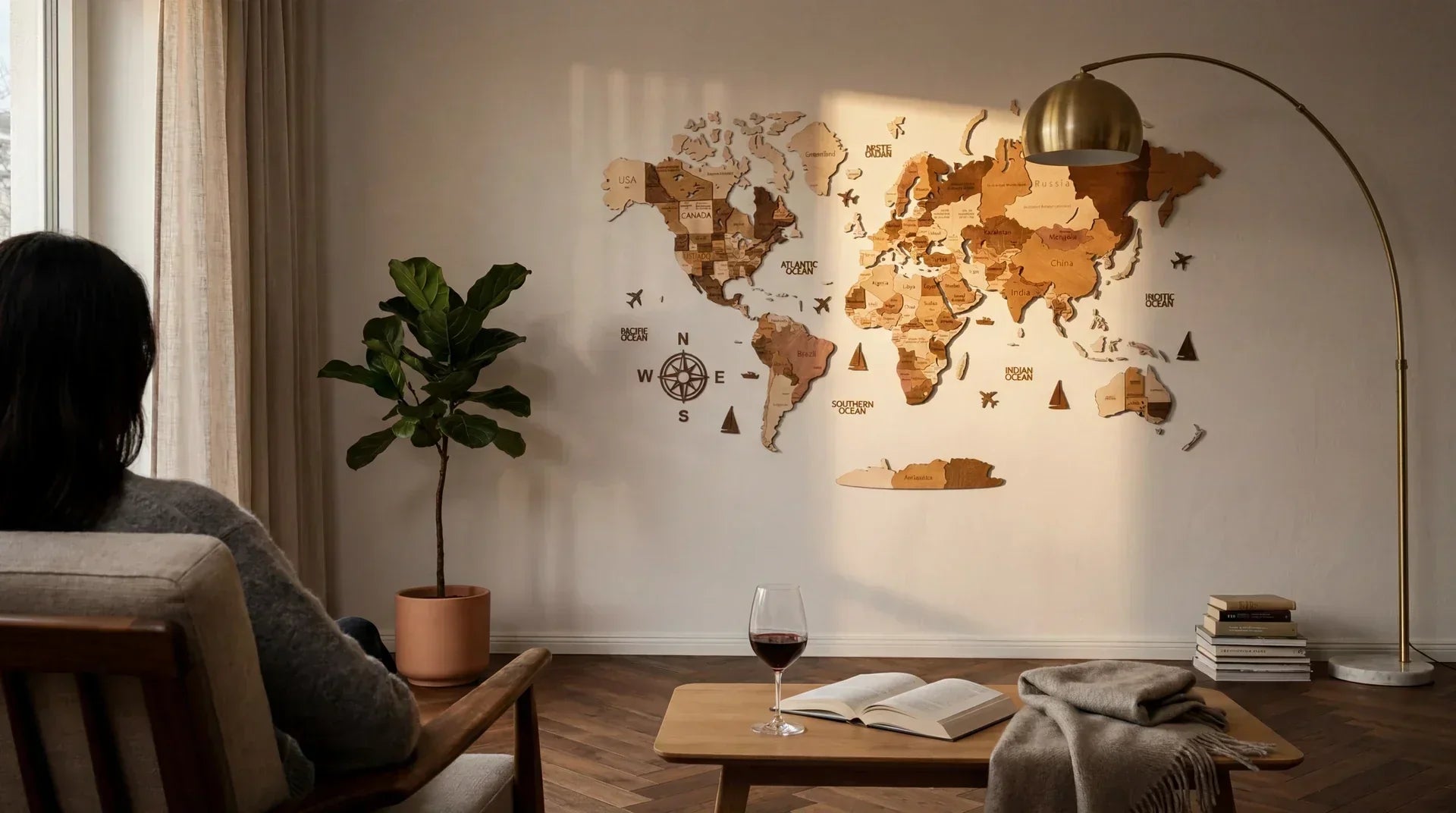
Most travel memory wall ideas start here — with a box, an empty wall, and the slow realisation that pinning everything up at once produces something that looks like a yearbook collage. The walls that last a decade work differently. The WOW WOOD editorial view, after years of looking at clients' homes: build around one large anchor (often a wooden world map with 297 pins), keep the supporting layer small, and let the wall stay mostly empty.
Why most travel walls don't survive
Walls that get boxed up within two years tend to share three habits. They get assembled in one weekend, they treat every souvenir as equal, and they're built without a hierarchy — twenty items at twenty different scales, all asking for the same attention.
Walls that last are built around a structural decision: one large object carries the wall, and everything else supports it. The supporting layer stays small on purpose. You're not building a museum of your trips. You're building a daily record you'll glance at on your way to the kitchen for the next fifteen years.
At a glance — WOW WOOD wooden world map specs
Includes 297 wooden pins · acrylic adhesive dots · illustrated installation guide in 8 languages · premium gift packaging · free EU shipping · lifetime replacement of small parts.
The two kinds of travel walls
There's the kind that gets a guest's attention for ninety seconds at a dinner party, and the kind you keep looking at when you're tired and the room is quiet. They aren't built the same way.
The first kind front-loads everything. Every souvenir gets a frame. Every photo gets a spot. The wall fills up in a single Sunday, peaks at month two, and starts to feel like clutter by month eight. Within two years it comes down — usually during a repaint — and most of it ends up in a box in the attic.
The second kind grows slowly. It starts with one object that earns the wall on its own. Then, across months and seasons, a few small pieces join it: a pin pressed in after a trip, a postmark from a card someone sent home, a small print framed at a size that doesn't compete with the anchor. The wall is mostly empty for the first year. That's the point.

The three elements that work
After looking at hundreds of homes — clients', friends', the ones photographed in design press — the walls that age well share the same three-part structure: an anchor, a time-marking layer, and a small curated set of objects.
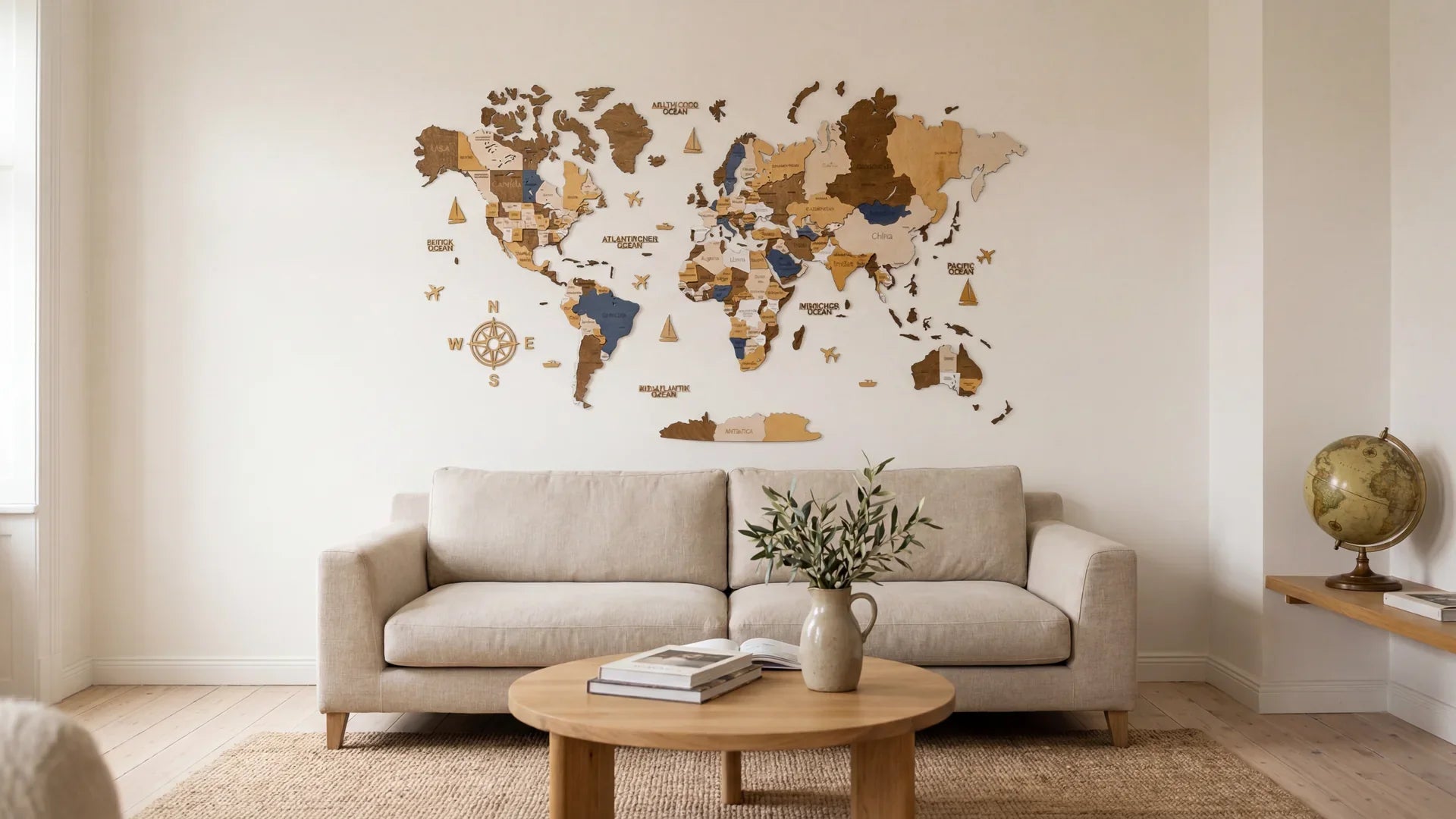
The anchor. One large piece, roughly two-thirds the width of the furniture below it. A framed map, a single oversized print, a wooden world map. The anchor sets the centre line of the wall and gives the eye somewhere obvious to land. Without an anchor, a travel wall reads as scatter.
The time-marking layer. This is what most people skip. A travel wall needs a way to log new trips without rearranging the whole composition. Pins pressed into a map. Dated postmarks under glass. Ticket stubs clipped to a small board. The time-marking layer is the part you add to. Everything else stays still.
The curated layer. Five to twelve supporting pieces. Not twenty. A printed photo you actually took. A small framed sketch from a Lisbon street vendor. A pressed olive leaf from a hillside you walked. The curated layer is where almost everyone overshoots. The rule worth following: if you can't say in one sentence why a piece is on the wall, it doesn't belong on the wall.
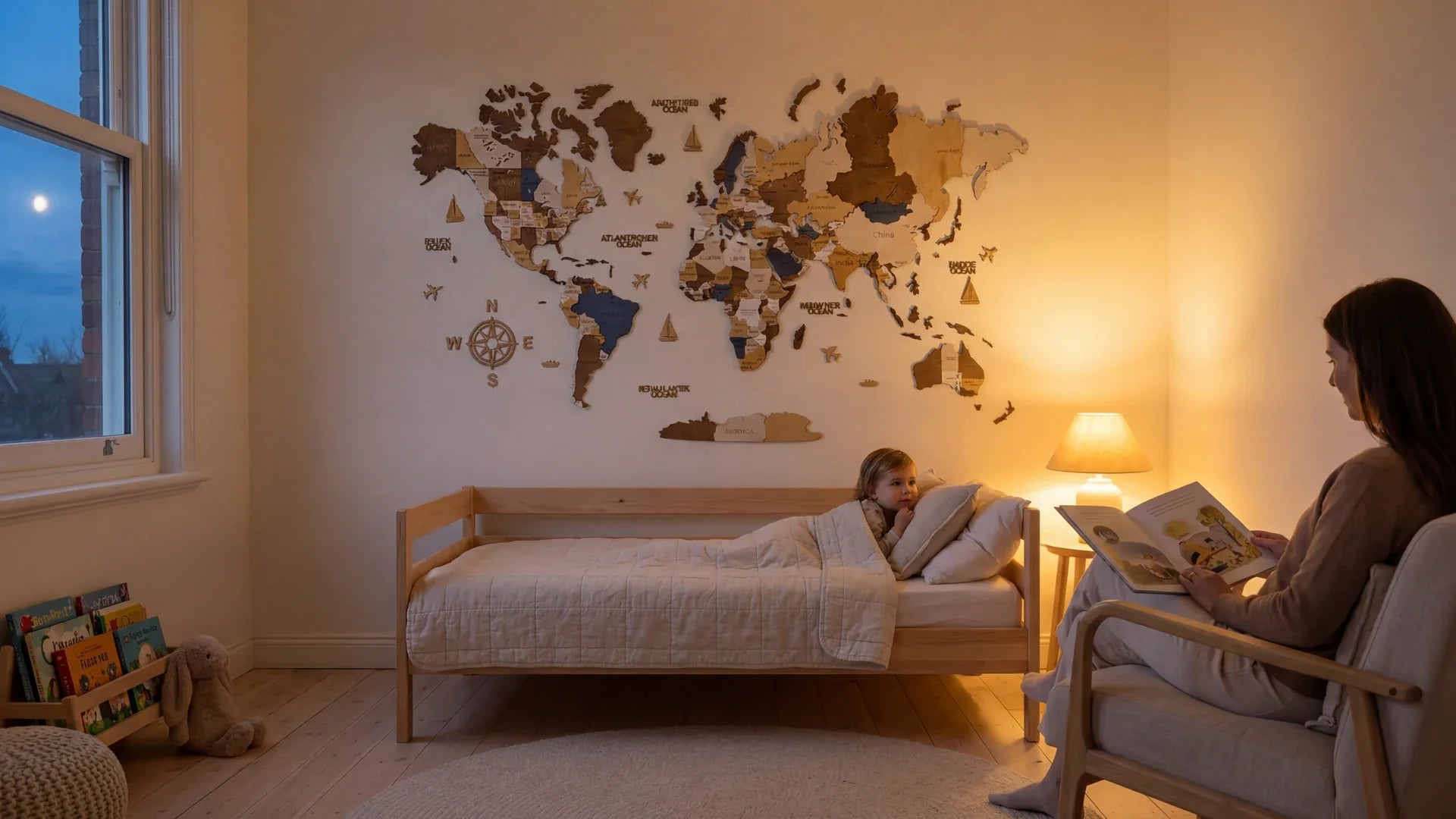
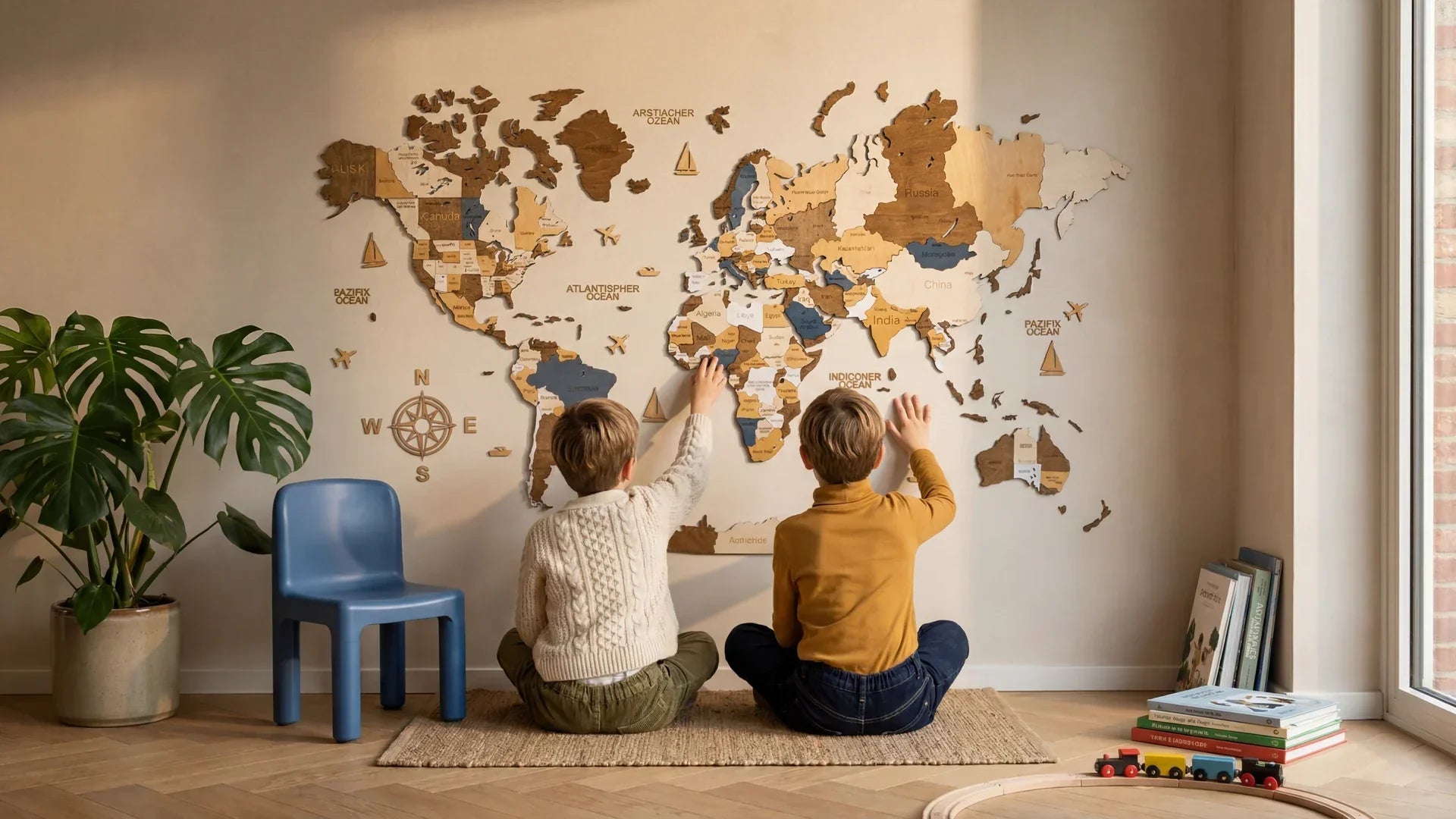
This is also where wooden maps earn their place. A wooden world map is the anchor and the time-marking layer in one piece. The map sits as the structural object; the pins handle the log. A WOW WOOD map ships with 297 pins, which is enough capacity for a lifetime of travel for almost any household. The 4 mm birch plywood gives the map enough depth to read as architecture on the wall, rather than as a poster.

What survives, what fades
Material choice is the part of a travel wall that gets noticed only when it's failed. By then it's been failing for a few years already.
Inkjet photographs are the most common casualty. Pigment-based inks last decades; dye-based inks on consumer printers can show visible fading within 2 to 5 years on a sunlit wall. The Image Permanence Institute at the Rochester Institute of Technology — one of the standing authorities on photographic preservation — has published accessible guidance on display recommendations for photographic materials that's worth reading before you hang any printed photograph on a south-facing wall.
Paper souvenirs — tickets, menus, maps — yellow faster than people expect. Acidic paper in particular can brown noticeably within five years of daily light exposure. Pressed flowers and leaves last roughly the same. They're worth including, but treat them as the layer that will rotate, not the layer that will stay.
What lasts: birch plywood (decades, stably), framed prints under UV-protective glazing, ceramics, metal objects, wood, and stitched textiles. The wooden map sits in this group — birch plywood is structurally stable across normal household humidity, doesn't yellow in the way paper does, and ages gracefully enough that ten-year-old maps look better than two-year-old ones. That's why we offer lifetime replacement on small parts: the maps outlive the pins.
Layout: the 60/30/10 rule and the measurements that matter
A useful adaptation of standard interior-design proportions: roughly 60% of the visual weight on one anchor, 30% on a small supporting cluster, 10% on accent details. It's a rough rule. It works.
In practice, this means the anchor sits at the visual centre of the wall, with its midline at roughly 145 to 150 cm above the floor. This is gallery-standard eye level for European adults. Above a dining table or sofa, drop the lower edge to within 20 to 30 cm of the furniture top.
The supporting cluster sits within a rough rectangle to one side or below the anchor. Items at varying sizes but consistent framing style. Edges aligned. The cluster reads as one shape.
The accent details — a single shelf with three small objects, a row of three small frames, a hanging textile — punctuate the composition. No more than two accent groups on a single wall.
Measure twice. Tape paper templates to the wall before drilling anything. Live with the templates for three days. You will move them.
For walls where drilling isn't an option — rental flats, plaster walls, surfaces you don't want to commit to — the WOW WOOD map ships with acrylic adhesive dots for no-drill installation. The dots hold cleanly on painted plaster and remove without residue. The map itself weighs 1.6 to 4.5 kg depending on size, well within the load range of the supplied dots.
Where in the home
The room you choose changes what the wall does.
Dining room walls are the most rewarding. You sit opposite the wall regularly, in good light, for an unhurried 30 to 60 minutes. The wall becomes part of how the room functions — guests ask about it, conversations start at the map. A dining wall is the strongest case for a large anchor.
Hallways work for narrower compositions and reward objects you glance at in passing. Hallway light is usually low and diffuse, which is kind to paper. The risk: hallways collect dust faster than other walls. Anything mounted there should be wipeable.
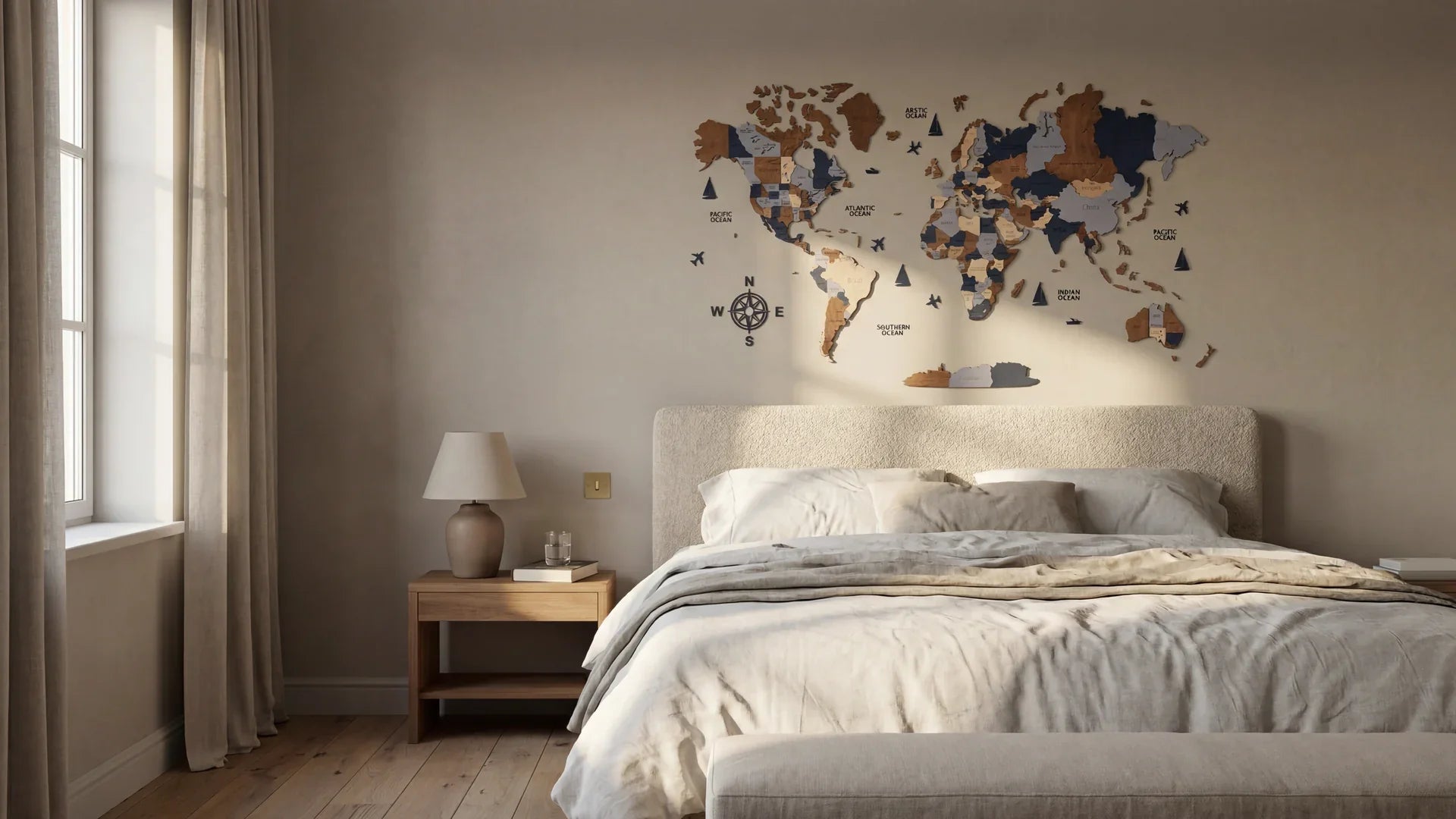
Bedrooms are the quietest setting and the easiest place to overlook a wall. If you put the anchor opposite the bed, it gets looked at twice a day — first thing and last thing. That's an unusual amount of attention. Choose the anchor accordingly.
Home offices are tempting and almost always a mistake for a full travel wall. The wall behind your desk shows up in every video call. The wall opposite the desk gets stared at when you're meant to be working. Pick one item — the anchor only — and leave the supporting layer for somewhere else in the house.
Avoid: walls in direct sun for more than two hours a day, walls above radiators, walls in bathrooms, kitchen walls within cooking-grease range. The first ages paper. The second warps frames. The third and fourth coat everything.
The souvenir problem
Most travel walls fail because the souvenirs fail. A wall isn't a storage system. It's a curated set of objects that earn the right to be looked at every day.
A useful typology, after watching clients build and rebuild these walls:
Wall-grade souvenirs. Things flat, framed, or pinnable. Small prints, postcards from people who actually wrote you something, pressed leaves, tickets with legible dates, a single textile patch. These belong on the wall.
Shelf-grade souvenirs. Ceramic, wooden, three-dimensional. A small bowl from a Marrakech market, a carved spoon, a stone. These belong on a shelf under or beside the wall — never pinned to the wall itself.
Drawer-grade souvenirs. The matchbook, the bottle cap, the receipt you kept. Most souvenirs are drawer-grade. That isn't a demotion. A box in a drawer is the right archive for the 80% of objects that carry a memory but don't earn a daily glance.
Throw-away. The mass-produced fridge magnet, the airport keychain, the duty-free chocolate wrapper. The honest test: would you buy this object today if you saw it in a shop at home. If no, it's not a souvenir. It's a habit.
Adding over time, and what to do when the wall fills up
The pacing of a travel wall matters more than its starting composition. A wall built across three years is structurally stronger than one built in a weekend, because the placement decisions get made one at a time and the wall has room to teach you what works.
A practical rhythm: add 1 to 3 pieces per trip. Wait at least two weeks after returning before placing anything. Most souvenirs lose their grip within a fortnight, and the ones that don't are the ones worth hanging. For pin-tracked trips, add the pin within the first week — the act of placing the pin is part of the homecoming — but resist adding the printed photo, the ticket, the menu until the trip has had time to settle.
When the wall fills — and it will, on every size below XL, within roughly a decade of regular travel — the answer isn't to expand the wall. It's to rotate. Move the older curated layer into a flat archive box. Photograph the wall in its current state before changing it (this matters more than people expect). Then rebuild the supporting layer with a smaller, more recent set. The anchor stays. The pins stay. The supporting layer turns over.
A wooden map handles this rotation well because the pins themselves don't need rotating — 297 pins is roughly 50 years of trips for an active traveller — and the underlying birch plywood doesn't fade in the way paper does. The map is the wall's long-term memory. Everything around it is short-term.
A note on the anchor
If the anchor is going to be a wooden map, choose the finish for the room first and the size for the wall second.
The Natural Wood finish reads warmly against painted plaster, brick, and most timber furniture. It's the version that feels least like a graphic object and most like a piece of joinery. WOW WOOD's Natural Wood wooden world map is the editor's pick for travel memory walls because the unstained birch ages closer to the supporting layer over time.
Dark Brown sits well in rooms with mid-tone walls and oak or walnut furniture. Multicolor is the most graphic option, the one that reads as a single statement piece and asks the supporting layer to stay quiet. All three are 4 mm birch plywood, hand-cut from the same sheet stock, with 297 pins included.
The L size (160 × 85 cm) is the bestseller for a reason. It's large enough to anchor a 220 cm dining wall or a standard sofa wall without feeling oversized in flats under 80 square metres. M works for hallways and bedrooms. XL is for double-height walls and large open-plan rooms.

Why this matters more than people think
The cognitive psychologist Maria Lewicka, at the Nicolaus Copernicus University in Toruń, has spent much of her career studying place attachment — the bond between people and the locations they've lived in, passed through, or returned to. Her review paper "Place attachment: How far have we come in the last 40 years?", published in 2011 in the Journal of Environmental Psychology (Vol. 31, Issue 3), points to something travel memory walls quietly do: physical anchors in domestic space reinforce autobiographical memory and a sense of continuity across the years.
In plain language: a wall you walk past every day, with a small set of physical objects that mark where you've been, does measurable work for how you remember your life. It's not decoration. It's a daily record.

Frequently Asked Questions
How do you display travel memories at home?
What is the best way to remember a trip?
How do you make a memory wall?
Where should you put a memory wall?
What do you put on a travel wall?
Do photos fade on a wall?
How big should a travel memory wall be?
A wall, mostly empty
Back to the box in the hallway. The honest answer to what to do with it: most of what's in there doesn't belong on the wall. The Lisbon menu, if it's dated and legible. The ferry tickets if they are. The ceramic tile belongs on a shelf, not on the wall. The receipt belongs in a drawer with a date written on it in pencil.
What goes on the wall is the anchor first — measured, hung, lived with for a few weeks before anything else joins it. Then the pin for the trip, pressed in once the suitcase is unpacked. Then, when the wall has had time to teach you what it wants, one or two of the small pieces from the box. The rest can wait. The wall is going to be there for a long time.
Related reading
- WOW WOOD's Natural Wood wooden world map — product details
- All WOW WOOD wooden world maps — the full collection
A quiet next step


If you've been circling the idea of a wooden map as the anchor, the full range — Natural Wood, Dark Brown, Multicolor, in three sizes from M at €119 — sits on the WOW WOOD wooden world maps collection page. Take your time with the choice. Walls that last get built slowly.
Written by the WOW WOOD editorial team. We've helped European households style their travel memory walls since 2022.

Share: